Spaceman by Pragmatic Play: Full Guide to the Crash Game, Cashout Mechanics, RTP, Provably Fair and Strategy

Last updated: February 2026 · Reviewed by: the iGaming analytics desk (hands-on testing in demo and real-money modes, cross-checked against provider documentation and published research)

In short. Spaceman is a crash game released by Pragmatic Play in March 2022. You stake before the round starts, an astronaut takes off, a multiplier climbs from 1.00x, and you must cash out before he crashes. The headline numbers are a base RTP of 96.50%, a maximum multiplier of 5,000x, a maximum win of $500,000 and a default bet range of $1.00 to $100.00 (some operators expose a lower floor of 0.10 depending on currency). The signature feature is Cashout 50%, which lets you bank half your stake at the current multiplier and leave the rest flying. You get roughly five seconds between rounds to place the next bet. No predictor, bot or "signal channel" beats the random generator, and no cashout pattern changes the house edge.
Spaceman by Pragmatic Play Full Guide

Why This Guide Matters Before Your First Deposit

Most Spaceman articles online read like a press release with a bet button attached. This one is built the other way round: parameters first, then the maths, then the parts nobody advertises.

If you are playing from Canada, three things decide your actual experience. Your province decides who is licensed to serve you (iGaming Ontario and the AGCO in Ontario, provincial lottery corporations such as BCLC, Loto-Québec, ALC and PlayAlberta elsewhere). Your payment method decides how quickly a win becomes money in your bank, with Interac e-Transfer and e-wallets typically the fastest CAD routes. And the operator's build of the game decides your RTP, which is not always the number quoted in reviews.

Age matters too. Ontario and most provinces set the bar at 19+, Alberta, Manitoba and Quebec at 18+. Check yours before you register anywhere.

Here is what that means for you in practice: read this guide as a checklist, not as motivation. The game is fast, the maths is fixed, and your only real levers are stake size, exit discipline and how many rounds you agree to play.

Why This Guide Matters Before Your

1. Spaceman at a Glance: Verified Technical Parameters

Before any strategy discussion, fix the numbers. Most disputes online about Spaceman come from mixing up the provider's base configuration with operator-specific builds.

Technical parameters of Spaceman (Pragmatic Play)

ParameterValue
ProviderPragmatic Play
ReleaseMarch 2022
GenreCrash game / instant win (not a slot: no reels, no paylines)
Maximum multiplier5,000x
Maximum win$500,000 (or currency equivalent, including CAD)
Minimum / maximum bet$1.00 / $100.00 default; some currencies and operators expose 0.10 as the floor
RTP (Return to Player)Base 96.50%, see the caveat below
VolatilityPlayer-controlled: determined by the cashout point you choose
Betting window between roundsroughly 5 seconds
Round lengthSeconds; even a run to 5,000x takes under about 1.5 minutes
Key featuresCashout, Cashout 50%, Auto Cashout, 50% Auto Cashout, live statistics, game history, leaderboard, live chat
TechnologyHTML5, browser-based, no download; iOS and Android supported
Bonus roundsNone. The multiplier is the game

Important: RTP ranges. Pragmatic Play ships Spaceman with configurable RTP ranges. The base figure quoted in provider materials and most reviews is 96.50%, but the provider's own game page lists 95%, and licensed operators in certain jurisdictions may run 95.00% or even lower variants. Both figures are correct, for different builds. Always open the in-client Help / Game Rules panel at the specific casino and read the RTP printed there before you stake. Never assume the number you saw in a review applies to your account.

This single detail resolves the most common contradiction between affiliate reviews (96.50%) and the provider's public page (95%). It matters more than it looks: half a percentage point of RTP is half a percent of every dollar you ever put through the game.

2. Spaceman as a Crash Game

2.1 Defining Spaceman and the Crash Game Format

A crash game strips gambling down to one variable: a rising number and the decision to stop it. In Spaceman there are no symbols, no scatters and no free spins. You commit a stake, the multiplier starts at 1.00x, it grows in real time, and it terminates at a pre-generated crash point. Cash out before that point and you are paid stake × multiplier at the moment of cashout. Miss it and the stake is lost in full.

No paylines. No second chance.

That mathematical description mirrors the conceptual structure of the game closely: a single continuous variable, a hidden stopping value, and a payout function that is entirely linear in the multiplier.

2.1 Defining Spaceman and the Crash

«Crash games are modelled as multiplayer pools in which the operator minimises guaranteed profit while maximising the share of players who win something in a round.» - Algorithmic Threshold Optimization, arXiv preprint (2026).

That framing is useful for players. The format is deliberately engineered so that many participants win small amounts frequently, which sustains engagement, while the rare deep-flight rounds carry the operator's margin. Frequent small wins are a design outcome, not evidence of a "hot table".

2.2 Structural Differences Between Crash Games and Slots

DimensionSpaceman (crash)Classic online slot
Outcome objectOne rising multiplierReel/payline combination
When outcome is fixedCrash point generated before flightResult generated at spin
Player agency after startYes, you choose the exitNone
Multiplier roleThe whole roundAttached to a winning or bonus outcome
Pacingroughly 5 s betting window, seconds-long roundsFixed spin cycle
Social layerLive chat, leaderboard, shared roundSolitary

The critical difference is psychological rather than mathematical. In an online slot the machine decides and you watch. In Spaceman you decide when to stop, which creates a powerful and misleading sense of skill, even though both formats use random processes to ensure that over long periods the operator retains a positive edge. This is why crash titles spread so quickly across the iGaming sector: they convert passive spinning into an active, repeatable decision, and active decisions are far more engaging than passive ones.

2.3 Developer Background: Pragmatic Play in the Crash Segment

Pragmatic Play is best known for slots, which is precisely why Spaceman is routinely, and incorrectly, filed under "online slot" in casino lobbies and review sites. Search "spaceman slots" and half the results will describe reels that do not exist. It is a crash game.

The studio publishes licences from the UK Gambling Commission and the Malta Gaming Authority, and lists a broader regulatory footprint including Gibraltar and Romania in its corporate materials. Its portfolio spans slots, live casino, bingo, virtual sports, table games and sportsbook content, and Spaceman sits inside its crash and instant-win line-up alongside its other multiplier-driven casino games.

For a player, the practical value of that licensing footprint is narrow but real: the game's RNG and RTP configurations are subject to independent test-lab certification in the regulated markets where it is distributed. In Canada, that certification travels with the game, but the operator still needs its own provincial authorisation to offer it to you.

2.3 Developer Background Pragmatic Play in

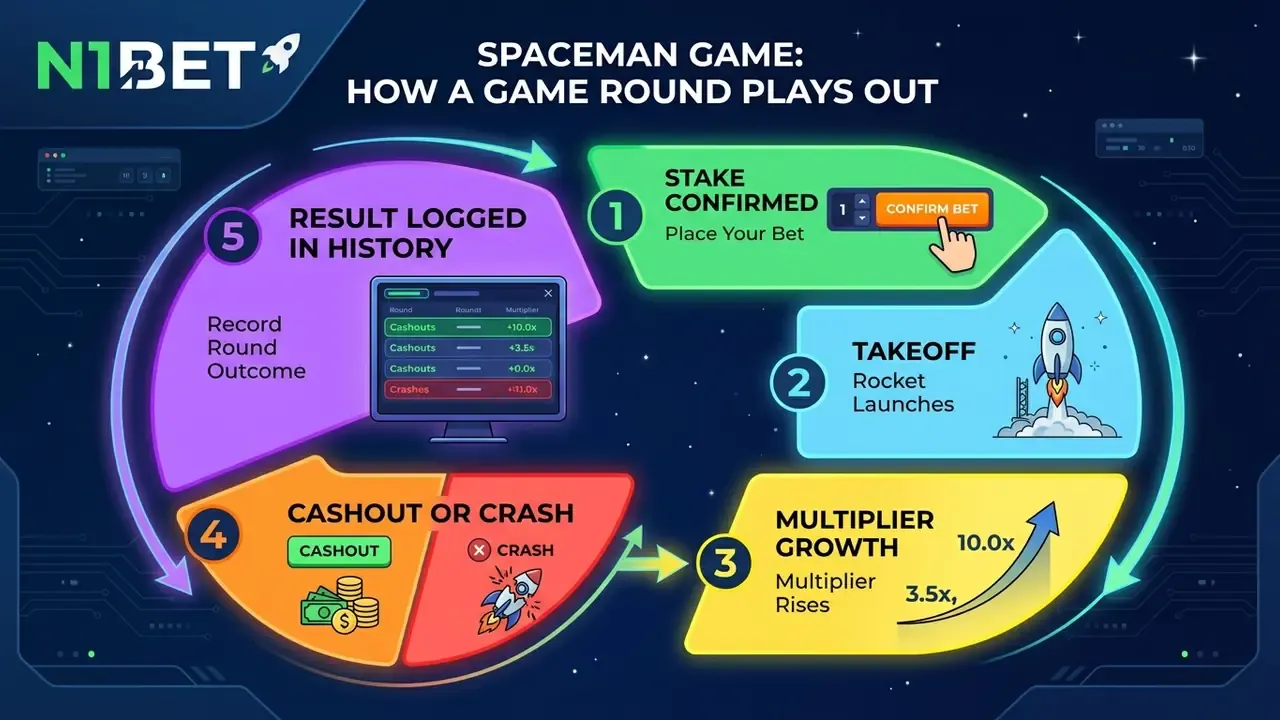
  1. How a Spaceman Round Works, Step by Step

1
Betting window opens. You have roughly five seconds to confirm a stake. Miss it and you sit out the round; the countdown does not wait.
2
Stake confirmation. Choose the amount within the operator's limits and press Confirm Bet. Any Auto Cashout or 50% Auto Cashout values must be set before takeoff.
3
Takeoff. The countdown hits zero, the astronaut launches, and the multiplier begins climbing from 1.00x.
4
Flight and growth. The multiplier rises continuously. The longer you hold, the larger the potential payout, and the higher the probability of losing everything.
5
Cashout decision. Press Cashout (full) or Cashout 50% (half). Payout equals the portion cashed out multiplied by the figure displayed at that instant.
6
Crash. The astronaut runs out of fuel and floats down under balloons. Any stake still in play at that moment is lost.
7
Result logging. The round's multiplier is appended to the history ticker at the bottom of the screen, the statistics panel and the leaderboard.

Because a full-length flight to the 5,000x ceiling takes under about a minute and a half, and typical rounds resolve in seconds, Spaceman can deliver dozens of decisions per ten minutes. That pace is the single most important risk factor here. More important than RTP, honestly.

  1. Interface, Controls and the First-Round Checklist

There are no reels and no paylines, so the interface is minimal by design:

  • Stake selector, from the minimum (1.00) to the maximum (100.00) in the base build.
  • Confirm Bet, which locks the stake for the upcoming round.
  • Cashout, which ends your participation and credits stake × current multiplier.
  • Cashout 50%, which banks half the stake at the current multiplier while the other half keeps flying.
  • Auto Cashout, a preset full exit at a chosen multiplier.
  • 50% Auto Cashout, a preset half exit at a chosen multiplier. The two can be combined.
  • History ticker, a running tape of recent crash multipliers along the bottom of the screen.
  • Statistics panel, showing the distribution of recent results, used and frequently abused for pattern-hunting.
  • Leaderboard, listing top players and their recent multipliers.
  • Live chat, real-time interaction with other players in the same round.
4. Interface, Controls and the First-Round

First-round checklist

  1. Launch the game in demo mode first and watch three to five rounds without staking.
  2. Open Help / Game Rules and record the RTP printed for this operator's build.
  3. Set a session budget in CAD and a loss limit before your first stake.
  4. Place the minimum stake to learn the timing of the five-second window.
  5. Set 50% Auto Cashout at 2.00x and a full Auto Cashout target, so your first live rounds do not depend on reflexes.
  6. Cash out. Then check the history ticker to see where the round actually crashed. This calibrates your expectations far faster than theory does.
  7. After ten rounds, stop and compare what you staked with what you hold.
First-round checklist. 1. Launch the game

A note on leaderboards. Seeing another player bank 40x is motivating, and that is exactly its function. Do not import someone else's risk tolerance into your own session; you are seeing their winning round, not their bankroll.

5. Cashout Mechanics: Manual, Auto and the 50% Feature

5.1 Manual Cashout vs Auto Cashout

Manual CashoutAuto Cashout
TriggerYou press the button mid-flightSystem fires at a preset multiplier
Set whenDuring the roundBefore the round starts
Best forDynamic exits, reacting to a deep flightFixed, disciplined targets
WeaknessLatency, hesitation, emotionYou cannot capitalise on an exceptional flight
Typical useHigher, variable multipliersLower, pre-committed multipliers (1.5x to 3x)

The honest summary: manual cashout is where discipline goes to die. Auto Cashout removes reaction time, connection lag and the "just one more second" impulse from the equation. If you cannot articulate in advance the multiplier at which you would exit, you do not have a plan. You have a reflex.

5.2 How the Unique "Cashout 50%" Feature Works

Unlike Aviator or JetX, Spaceman lets you bank half of your position and leave the remainder in play. This is the mechanic that most reviews mention and almost none actually calculate.

Worked example:

  1. You stake $10.
  2. At 2.00x you press Cashout 50%.
    • You bank: $5 × 2.00 = $10, your entire original stake returned.
    • Still in play: $5 of risk.
  3. The astronaut reaches 5.00x and you press full Cashout.
    • You bank: $5 × 5.00 = $25.
  4. Total returned: $35, a net profit of $25, with zero net exposure after the 2.00x mark.

Scenario table, $10 stake, 50% banked at 2.00x, remainder held:

5.2 How the Unique Cashout 50
Remaining half exits atBanked at 2.00xSecond payoutTotal returnedNet result
Crash (no exit)$10$0$10$0, break-even
2.50x$10$12.50$22.50+$12.50
3.50x$10$17.50$27.50+$17.50
5.00x$10$25.00$35.00+$25.00
10.00x$10$50.00$60.00+$50.00
50.00x$10$250.00$260.00+$250.00

Note the first row. Banking half at exactly 2.00x converts the round into a free option: the worst case is break-even, the best case is uncapped up to 5,000x. That is the strongest structural argument for the feature. It is also worth being clear that this does not change the game's RTP. It reshapes the distribution of your outcomes (more break-evens, fewer total losses, fewer maximum wins), not the long-run expectation.

A second worked example at a lower exit, for clarity: stake 10 coins, press Cashout 50% at 3.00x and you collect 5 × 3.00 = 15 coins while 5 coins stay airborne. Even if the astronaut crashes one tick later, you are up 5 coins on the round.

Note the first row. Banking half

5.3 Managing Two Stakes in One Round: What Is and Is Not Confirmed

Several strategy guides describe a "double bet" workflow for crash games: two independent stakes in the same round, one with a low Auto Cashout target, the other held for a deep multiplier. This dual-panel setup is documented for some competing crash titles, but we could not verify a two-independent-bets panel in Pragmatic Play's official Spaceman rules. Treat it as operator- or client-dependent and check the game's Help section before planning around it. Requires verification against your operator's build.

What Spaceman does give you natively is functionally similar and fully confirmed: 50% Auto Cashout at a low multiplier plus full Auto Cashout at a high one. That is the in-game equivalent of "one safe bet and one runner", executed with a single stake and a single total exposure you can actually track.

5.3 Managing Two Stakes in One

5.4 Cashout Outcomes and Behavioural Phenotypes

Who cashes out early, and who holds? Experimental work on cashout offers found a negative correlation between self-reported impulsivity and frequency of cashout acceptance.

«More impulsive participants accepted cashout offers less often, preferring to keep the stake in play in pursuit of a higher return.» - Experimental study of impulsivity and cashout preferences (2023 to 2026).

The practical reading for Spaceman players: the impulse to "let it ride" is not a sign of superior nerve or a read on the round. It is a measurable behavioural trait that correlates with weaker restraint. If holding past your planned exit feels natural to you, pre-commit with Auto Cashout rather than trusting the moment.

6. Provably Fair and RNG: How to Verify a Round

Spaceman's outcomes are produced by a random number generator, and in provably fair implementations the crash point for each round is generated before the round begins and is cryptographically committed, so the server cannot alter it once betting closes.

How to check the fairness of a round

  1. Open the round history (the statistics / history icon in the interface).
  2. Copy the round's Server Seed (published as an encrypted hash before the round, revealed afterwards) and the Client Seed.
  3. Open any third-party SHA-256 generator.
  4. Concatenate the string: Server Seed + Client Seed + Nonce (round number).
  5. Hash it. The resulting hash maps to the round's crash multiplier via the game's published formula. If it matches the recorded result, the round was not manipulated.

Provably Fair is used across instant-win formats, including Plinko, Keno and HiLo, and it is generally presented as an improvement in transparency over a closed RNG, because the player can audit individual rounds instead of trusting periodic lab certification alone.

What Provably Fair does not do. It proves that a specific round was not tampered with. It does not make the game beatable, does not remove the house edge, and does not make crash points predictable. Any tool claiming to forecast a provably fair crash point is claiming to break SHA-256. Consider what that claim would actually be worth if it were true.

How to check the fairness of

7. Maths: RTP, House Edge, Expected Value and the 5,000x Ceiling

7.1 Return to Player and House Edge in Spaceman

At the base configuration of 96.50%, the theoretical house edge is 3.50%: over a very large number of rounds, the game returns $96.50 per $100 staked. On a 95.00% build, the edge is 5.00%. Return to player is a long-run statistical property of millions of rounds, not a promise about your session, your day or your month.

That distinction matters more than it sounds, because RTP disclosures are routinely misread as favourable odds.

«A standard RTP statement raised players' perceived chances of winning, with an odds ratio above 5 compared with a group given no information.» - "Never tell me the odds", study of 6,062 slots players in the UK and US (2025).

In other words, participants exposed to an RTP statement perceived their chances of winning to be significantly higher than those who saw none. A 96.50% figure reads to many people as "I win about 96% of the time". It means close to the opposite: the expected long-run loss is 3.5% of everything you stake, and the more rounds you play, the more reliably that loss shows up.

7.2 Expected Value: Why No Cashout Point Beats the Edge

The tempting intuition is that a "smart" exit multiplier flips the maths. It does not. In a crash game with a fixed RTP, the probability of surviving to any multiplier m is calibrated so that the expected value of every exit strategy converges to the same negative number:

EV ≈ stake × (RTP − 1)

  • Exit at 1.20x: you win often, each win is tiny. EV is about −3.5% per unit staked.
  • Exit at 2.00x: roughly a coin-flip shape, moderate payouts. EV is about −3.5%.
  • Exit at 100x: you almost always lose, occasionally enormously. EV is about −3.5%.

What your exit choice genuinely controls is variance, meaning how violently your balance swings and how long your bankroll survives. Low targets produce shallow, frequent movement. High targets produce long droughts punctuated by spikes. Neither creates an edge. Anyone selling you a "profitable multiplier" is selling variance dressed up as an advantage.

7.2 Expected Value Why No Cashout

7.3 Maximum Multiplier and Maximum Win

The ceiling is 5,000x, capped at $500,000 in absolute terms. Two consequences follow. First, on a $100 maximum stake the theoretical top prize is reachable only within the operator's payout cap, so check that cap in the terms. Second, 5,000x rounds are extraordinarily rare, and planning a session around one is roughly like planning a household budget around a lottery ticket.

8. Spaceman Strategies: Maths vs Myths

Nothing below changes the house edge. These are variance-management and discipline frameworks, not winning systems.

8.1 Strategy 1: Double Insurance (the 50% Auto Cashout method)

  • Setup:50% Auto Cashout at 2.00x, full Auto Cashout at 3.50x to 5.00x.
  • Why it works as a framework:at 2.00x the banked half returns your entire original stake. Everything the remaining half earns is unrisked upside, and the worst realistic outcome for the round is break-even.
  • Trade-off:you will book a lot of zero-net rounds. That is the price of the free option, and across many rounds the 3.5% edge still applies to total turnover.
8.1 Strategy 1 Double Insurance the

8.2 Strategy 2: Stats-Based Entry

Watch the live statistics panel. Wait for a run of low multipliers between 1.00x and 1.50x, say five to ten in a row. Enter the next round with two equal-sized positions (or, in Spaceman terms, one stake split via the 50% features): set the first exit at 2.00x, and target the second at roughly the average multiplier of the last 10 to 20 rounds.

Read this honestly: rounds are independent. A cluster of low multipliers does not make a high one "due"; that is the gambler's fallacy, and provably fair generation guarantees independence. What a stats-based rule actually delivers is procedure. It forces you to skip rounds, which mechanically reduces turnover, and turnover is the only variable that reliably drives long-run loss. Use it as a discipline device, not as a prediction engine.

8.2 Strategy 2 Stats-Based Entry. Watch

8.3 Why You Must Not Use Martingale

Many casino guides recommend doubling after a loss. It is a high-risk, low-reward system and we strongly advise against it.

Consecutive lossRequired stake ($1 base)Cumulative loss
1$1$1
2$2$3
3$4$7
4$8$15
5$16$31
6$32$63
7$128$127

Three reasons this collapses in Spaceman specifically:

  1. Losing streaks are common at the low exit multipliers Martingale requires. Seven in a row is not exotic.
  2. The table limit blocks recovery. With a $100 maximum bet, the seventh doubling step ($128) is impossible to place. Your recovery chain breaks precisely when you need it.
  3. Terms and conditions. Many operators explicitly prohibit systematic Martingale-style progression, and systematic use is treated as bonus abuse in a large share of casino T&Cs, meaning even a "successful" run can be voided at withdrawal.

8.4 Anti-Martingale (positive progression)

The inverse approach: increase stakes only from won money, and reduce to base after any loss. Example: base $2; after a winning round, stake $3 out of a $6 return; after a loss, reset to $2. Your downside stays bounded by your base unit, and escalation is funded by profit rather than by debt. It does not beat the edge either. But it cannot detonate a bankroll in seven rounds, and that is worth something.

8.5 Bankroll and Session Rules That Actually Move the Needle

  • Unit sizing:one stake at or below 1 to 2% of the session bankroll.
  • Stop-loss:a fixed cash figure, decided before launch, that ends the session. No exceptions, and no "one more round to get back to even".
  • Stop-win:bank a defined portion of profit and withdraw it immediately.
  • Round cap:count rounds, not minutes. A five-second betting window means time-based limits systematically underestimate exposure.
  • Never chase.With five-second cycles, chasing losses can burn a bankroll in under ten minutes.
8.5 Bankroll and Session Rules That

8.6 Game Design Features Relevant to Player Protection and Risk

Auto-bet and auto-cashout are usually framed as convenience features, and they genuinely help enforce exits. But automation also removes friction from the act of staking, and friction is protective. A quasi-experiment on an operator's platform found that introducing auto-play increased total gambling activity by roughly 7 to 9%.

«Introducing auto-play increased total wagering volume by 6.9–9.1% and spin counts by roughly 3%, without changing players' net losses.» - Quasi-experimental study of auto-play on an online casino, Bayesian time-series analysis (2023 to 2024).

Read the two halves together: more money staked, same net loss. Automation increased throughput without improving results. Use Auto Cashout to enforce your exit; be far more cautious with auto-bet, which enforces nothing except that you keep playing.

9. Spaceman Demo vs Real-Money Play

9.1 What You Can Test Risk-Free

Spaceman demo runs on a virtual balance with no cash value and no withdrawal path, while preserving the real game's interface and mathematics. Yes, the demo keeps the same RTP and the same round generation, so what you learn about pacing and mechanics transfers directly to spaceman real money play. What you can safely rehearse when you play free:

  • The five-second betting rhythm and the Confirm Bet flow.
  • Stake selection and the operator's limit range.
  • Cashout against Cashout 50% button placement and latency.
  • Configuring Auto Cashout and 50% Auto Cashout targets, including combined setups.
  • Reading the history ticker, statistics panel and leaderboard.
  • Verifying a round through the Provably Fair panel.

Demo mode is normally available on the provider's own game page and inside licensed casinos, though the exact demo feature set can vary by operator build. If a site refuses any free access at all, that is a small transparency flag rather than a dealbreaker.

9.1 What You Can Test Risk-Free

9.2 Psychological and Behavioural Differences

Free play is a legitimate learning tool with a documented side effect. In experimental work, participants who were pre-exposed to free-play sessions bet significantly more per spin in the subsequent real-money task.

«Prior exposure to free-play sessions increased stake sizes in the following real-money task, regardless of the outcome of the free session.» - Report on the convergence of simulated and monetary gambling (2023).

The mechanism is straightforward. In demo mode a $50 stake costs nothing, and after twenty rounds of costless $50 stakes, $50 stops feeling like $50. Countermeasure: run demo sessions at the exact stake you intend to use with real money, and set your deposit and loss limits before you switch modes, not after.

10. Spaceman Mobile: Browser Requirements and Regional Access

10.1 HTML5, No Download

Spaceman is built in HTML5 and runs directly in desktop and mobile browsers with no app or plug-in download, on both iOS and Android. Practical requirements: a modern browser and a stable connection. Because cashout is time-critical to a fraction of a second, latency is a genuine risk factor. On an unstable mobile connection, use Auto Cashout rather than tapping manually, or you may watch a payout evaporate into a dropped packet.

On a phone the controls sit close together, so set your stake and your auto targets before takeoff rather than during the climb. One mistimed thumb is one lost round.

Be wary of anything presenting itself as a downloadable "Spaceman APK", "predictor" or "hack tool". The legitimate game requires no installation, so an installer is a red flag by definition, and several of these packages exist purely to harvest casino logins.

10.1 HTML5, No Download. Spaceman is

10.2 Smartphone Betting Features Linked to Harm

Convenience is not neutral. Analysis of situational gambling factors found that greater short-term betting harm was significantly associated with the ability to bet anywhere, at any time.

«Only smartphone betting combines all three situational factors linked to short-term harm: anytime availability, privacy, and expanded access to promotions.» - Study of situational smartphone-betting factors, factor analysis (2024).

Applied to a game with five-second cycles, this is the highest-risk combination in the article: an unlimited number of decisions, available in any private moment, with promotional prompts one tap away.

10.3 Availability of Spaceman in Online Casinos and Regional Access

Spaceman is widely deployed across online casinos that license Pragmatic Play's portfolio, including crypto-friendly operators, and in the United States structurally similar crash titles appear at sweepstakes sites, where a Crash variant with a different RTP and multiplier ceiling often stands in for Spaceman itself.

On device usage, regulator-adjacent reporting is unambiguous. In a state-level review where roughly 11% of the adult population engaged in some form of online gambling:

«About 81.5% of online gamblers used a mobile phone as their primary device, and 80% used only one device.» - Pennsylvania online gambling report (2023).

Access itself is jurisdiction-dependent. A licensed operator must publish where its service is offered or blocked, and legal age thresholds differ: 18+ in most European markets, 19+ in Ontario and several Canadian provinces, 21+ at some US-facing platforms. Availability of the game at a given brand is never a guarantee that it is available to you.

11. Bonuses, Promotional Offers and Responsible Spaceman Play

Disclaimer. This information is general in nature and does not replace professional advice. Gambling carries financial risk. If play stops being enjoyable or begins causing stress, contact a problem-gambling support service in your jurisdiction.

11.1 Impact of Free Bets and Promotions on Gambling Behaviour

Bonus funds and free bets are the standard on-ramp to crash games, and higher-risk individuals are also more likely to agree that these incentives influence the amount they gamble.

«63% of problem gamblers felt they received too many incentives to gamble; 77% of them said bonuses prompted them to gamble more than they had planned.» - UK Gambling Commission White Paper, "High Stakes: Gambling Reform for the Digital Age" (2023).

Those two figures should reframe how you read a welcome offer. A bonus is not free money. It is a mechanism designed to increase turnover, and turnover is the exact variable that converts a 3.5% house edge into a real loss.

One more thing worth stating plainly, because the phrase circulates in search: there is no Spaceman bonus buy feature. Bonus buy belongs to slots, where you pay a premium to trigger free spins. Spaceman has no free spins, no feature purchase and no bonus round of any kind. If a site advertises a "spaceman bonus buy", it is describing a game that does not exist.

11.2 Empirical Evidence on Wagering Requirements and Miscomprehension

Wagering requirements are systematically misunderstood, even by numerate players. In a controlled experiment, control-condition participants significantly underestimated the requirement, with a median estimate of £500 against a correct value of £750. Showing a worked example changed both comprehension and appetite:

«Bonus appeal fell significantly when a worked wagering example was displayed: mean rating dropped from 3.75 to 2.39 (p<.001, η²=.18).» - Journal of Gambling Studies, experimental study of wagering requirements, UK (2026).

Do the arithmetic yourself, every time. A $50 bonus at 15x wagering demands $750 of turnover. On a 96.50% RTP game, $750 of turnover carries an expected loss of roughly $26 before you can withdraw anything. Also check whether crash games contribute to wagering at all, because many bonus terms weight them at 10% or exclude them outright, and some operators prohibit progression systems while a bonus is active. Read the T&Cs line by line; the catch is usually in one clause.

11.3 Responsible Gambling Messages and Withdrawal Nudges

There is encouraging evidence that lightweight interventions work. In a randomised field study, 38% of gamblers who read a "winning streak" message withdrew money from their account on the same day.

«Personalised behavioural messages produced a significant reduction in the amount staked in the seven days following the message.» - "Nudging Online Gamblers to Withdraw Money", randomised study (2024).

You can self-administer this. Withdraw on the day you win, not "later in the week". In Canada an Interac e-Transfer withdrawal often clears within hours once verification is complete, so there is rarely a practical excuse to leave it sitting. Money left in a casino balance is not profit. It is inventory waiting to be redeployed into a negative-EV game.

11.4 ⚠️ Important: Alert Box

  • Real-money play carries a real risk of financial loss.
  • The game holds a structural mathematical edge (3.50% at 96.50% RTP; 5.00% at 95%). The expected long-run return is below 100%.
  • No strategy, system, cashout pattern, bot or "signal" removes that edge. Provably Fair guarantees integrity, not predictability.
  • No outcome in any single round is guaranteed. Past multipliers carry zero information about the next one.
  • Stake only discretionary funds. Never gamble with borrowed money or funds allocated to essentials.
  • Use operator tools: deposit limits, loss limits, session reminders, reality checks, self-exclusion.
  • If gambling is affecting your finances, relationships, work or mental health, seek support. In Ontario, ConnexOntario is available on 1-866-531-2600; in British Columbia, the Problem Gambling Help Line runs 24/7; in Great Britain, GambleAware provides free confidential help. Equivalent services exist in most regulated markets.
11.4 Important Alert Box. - Real-money

  1. How to Choose a Casino for Spaceman

1
Licence. A verifiable, published licence from a recognised regulator (AGCO and iGaming Ontario for Ontario players, a provincial lottery corporation elsewhere in Canada, or UKGC and MGA internationally), naming the operating entity. If you cannot identify who holds the licence and in which jurisdiction, stop there.
2
Declared RTP for this build. Because Spaceman ships with configurable RTP ranges, the in-client Help panel is the only authoritative source. A casino running a 94 to 95% variant is measurably worse value than one running 96.50%.
3
Demo availability. A free mode you can open before registering, or at minimum before depositing, is both a transparency signal and a practical training tool.
4
Published bonus terms and regional restrictions. Wagering multiplier, game contribution for crash titles, maximum bet while a bonus is active, withdrawal caps, expiry windows, and a clear list of restricted territories, all stated before acceptance.
CheckWhat good looks likeWhy it matters to you
Spaceman available in lobbyListed under crash or instant win, Pragmatic Play brandedConfirms a licensed build, not a clone
Demo modePlayable before depositYou learn the five-second window at zero cost
Mobile experienceHTML5 in-browser, no APKStable cashout timing, no installer risk
RTP shown in Help panel96.50% stated in-clientHalf a percent of every dollar staked
CAD bankingInterac e-Transfer, e-wallets, no FX markupFaster withdrawals, fewer hidden costs
Withdrawal speed and limitsPublished timelines and monthly capsTells you when a win becomes money
Bonus termsWagering, contribution for crash games, max betDecides whether the offer is real value
Age and jurisdiction19+ in Ontario and most provinces, stated clearlyLegality and account verification

Conditions and restrictions vary by operator and by province, and figures change without notice. Verify each line in the operator's own terms rather than in any review, including this one.

  1. Spaceman vs Other Crash Games

ParameterSpaceman (Pragmatic Play)Aviator (Spribe)Stake CrashJetX (SmartSoft)High Flyer (BGaming)
RTP96.50% (base; 95% builds exist)about 97.00%about 99.00%Operator-dependentOperator-dependent
Max multiplier5,000x10,000x plus1,000,000xHigh, provider-dependentProvider-dependent
50% CashoutYes, built inNoNoNoNo
Provably FairYesYesYesVariesVaries
Live chatYesYesYesVariesVaries
Betting windowabout 5 secondsabout 5 secondsDynamicShortShort
ThemeAstronaut and deep spaceAircraftAbstract rising lineJet aircraftAviation

Are There Similar Crash Games?

All of these titles share the same core loop, which is stake before takeoff, watch a multiplier climb, exit before the crash. They differ mainly in theme, presentation, ceiling and provider implementation. Aviator is the segment's best-known title and adds tournaments and a strong social layer. JetX offers a jet-fighter aesthetic with the same crash resolution. High Flyer is BGaming's take on the identical mechanic. Stake Crash replaces character animation with a rising line and, in its social-casino form, advertises a substantially higher RTP and an extreme multiplier ceiling.

On comparative RTPs: figures such as Aviator at 97.00% or Stake Crash at 99.00% are quoted by operators and review sites rather than verified by an independent laboratory in the sources available to us. Treat all cross-title RTP comparisons as indicative, not audited, and confirm each figure in the specific game client you are using. RTP configurability applies across the segment, not only to Spaceman. Requires independent verification.

What is genuinely distinctive here is the native Cashout 50% function. Among mainstream crash titles, the ability to bank half a stake mid-flight while leaving the remainder exposed is unusual, and it is the single mechanical reason to prefer Spaceman over a higher-RTP competitor if structured risk management matters more to you than a marginal edge improvement.

Are There Similar Crash Games

  1. Evidence Gaps: What We Still Cannot Verify

Honest reporting includes what is unknown.

  • Player-base figures. Industry reviews cite popularity claims for Spaceman, with figures in the range of "roughly 12 million players" circulating widely. We could not identify a methodology, sample definition, time window or independent audit behind that number, so we do not treat it as a verified statistic. Requires primary data from the provider.
  • Spaceman-specific harm research. The behavioural evidence cited in this guide concerns crash games, auto-play, RTP messaging, bonuses and smartphone gambling in general. No peer-reviewed study isolating outcomes for this title specifically was available to us. Conclusions here are extrapolated from format-level and platform-level research.
  • Operator-level RTP distribution. How many casinos deploy 96.50% versus 95.00% versus lower builds is not publicly reported. This is precisely why checking the in-game Help panel is not optional.
  • Demo feature parity. Whether every demo build exposes the full statistics, leaderboard and Provably Fair panels varies by operator and is not documented centrally.
  • Exact bet floor. Provider specifications and operator lobbies quote both 1.00 and 0.10 as minimums depending on currency and locale. Verify in the client.
  • Canadian availability by province. Which regulated Canadian brands carry the title at any given moment: no data we can verify centrally. Search the lobby yourself.
14. Evidence Gaps What We Still

  1. FAQ About the Spaceman Casino Game

Do predictors, hacks or signal bots for Spaceman exist?

No. Outcomes are produced by a random number generator under a Provably Fair scheme, with crash points committed cryptographically before each round. Any software, bot, APK or Telegram channel selling "Spaceman signals" is fraudulent, and many are credential-harvesting scams on top of that.

How long do I have to place a bet between rounds?

Roughly five seconds. Use auto-bet or pre-set Auto Cashout values if you find the window tight, but see the caution on automation and turnover above.

Can I play Spaceman for free?

Yes. Spaceman demo is available on Pragmatic Play's game page and at licensed casinos. It uses a virtual, non-withdrawable balance and preserves the real game's mathematics and RTP, so you can play free without any deposit.

Do I need to download Spaceman?

No. The game is HTML5 and loads in your browser at any online casino that carries it, on desktop, tablet and phone. There is no official app and no APK. If your operator offers a casino app, the title simply runs inside it, and anything else advertising itself as a Spaceman installer should be avoided.

Is Spaceman a slot?

No. It has no reels, paylines or bonus rounds. It is a crash game, and the multiplier of up to 5,000x from the main round is the only payout mechanism. Lobbies file it under slots because Pragmatic Play is primarily a slots studio, which is how "spaceman slot" became the common search term.

What is the difference between Auto Cashout and 50% Auto Cashout?

Auto Cashout exits your entire stake automatically at a multiplier you set in advance. 50% Auto Cashout banks half your stake at your chosen multiplier and leaves the other half in play. They can be combined, for example half out at 2.00x with the remainder auto-exiting at 5.00x.

Is Spaceman's RTP 96.50% or 95%?

Both figures exist. 96.50% is the base configuration cited in provider materials and most reviews, while Pragmatic Play's public game page lists 95%, and operators may run other configured variants. Read the RTP in your casino's in-game Help panel.

Can I play on mobile?

Yes. Spaceman mobile is the same HTML5 build and runs in iOS and Android browsers with no download. On unstable connections, prefer Auto Cashout to manual tapping.

Why is Spaceman so popular?

Three reasons, mostly. Rounds last seconds, so a session delivers many decisions quickly. The mechanic takes about twenty seconds to understand: stake, watch, cash out. And the space theme with live chat and a leaderboard makes it feel shared rather than solitary. The Cashout 50% option adds a genuine decision that competing crash titles do not offer.

Does the history ticker help me predict the next round?

No. Rounds are independent, and provably fair generation guarantees that independence. A stats-based routine is useful only as a discipline device that reduces the number of rounds you play.

Is Spaceman fair?

It is built on a certified RNG, supplied by a provider licensed in regulated markets, and in provably fair implementations it is auditable round by round. "Fair" means the results are not manipulated. It does not mean the game is neutral. The house edge is 3.50% at 96.50% RTP.