In two sentences: Balloon is a crash game where a rising multiplier is tied to an inflating balloon, and the burst point is fixed by the server before you start holding. Your only decision is when to release.
The Balloon game is a continuous crash-style casino game built by SmartSoft Gaming in 2019. Players inflate a virtual balloon to grow a payout multiplier while carrying the constant risk of an immediate burst that forfeits the stake. Unlike classic video slots with paylines, wilds, or scatter triggers, this casino game runs on a single exponential curve that sets the length of each round.
[SCHEME: Balloon game crash multiplier curve. Alt text: balloon game crash multiplier curve.]
Curve description in text: the multiplier starts at 1.00x at round start, climbs through the 1.10x and 1.50x band within the first moments of the inflation phase, passes 2.50x and 5.00x as the balloon swells, and approaches the 10.00x region only in a small share of rounds. Burst risk rises along the whole curve, not just at the top. The visible line is smooth; the ending is not.
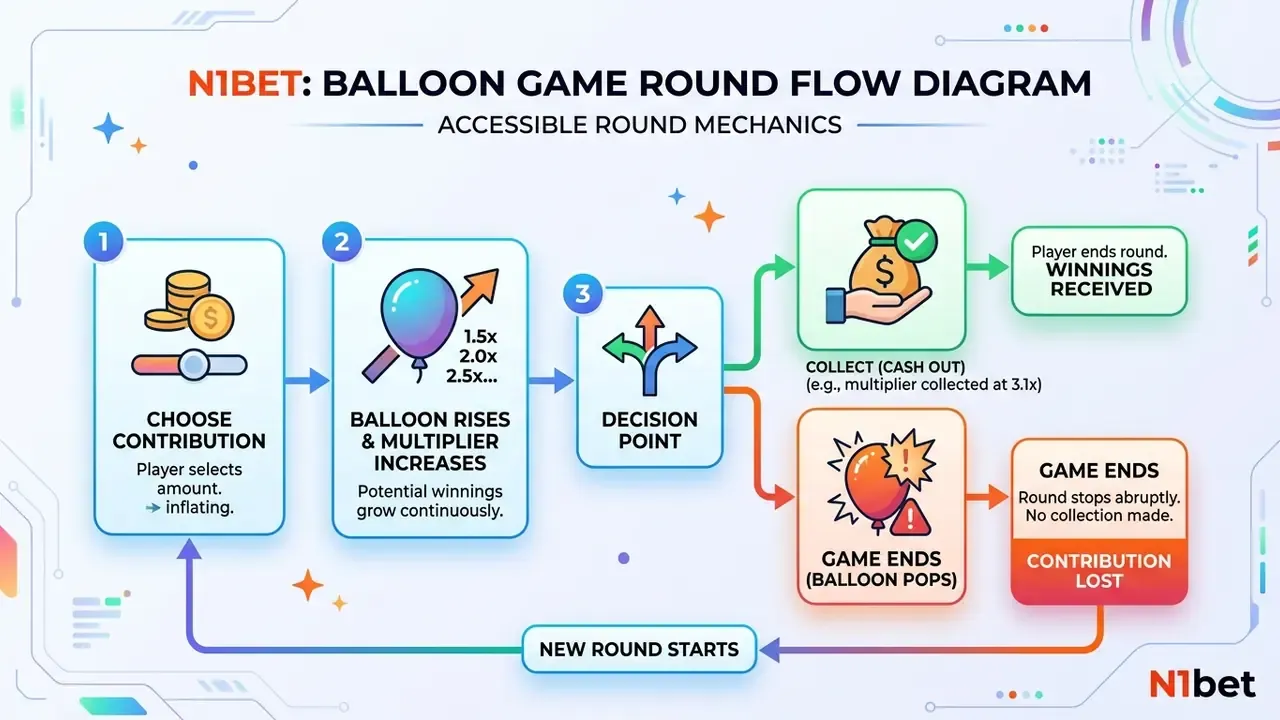
The crash mechanic relies on a pre-committed random outcome generated by a Random Number Generator (RNG) or a cryptographic algorithm before the round begins. Once a bet is placed and inflation starts, the visible multiplier climbs from 1.00x upward. The defining feature of this gameplay is that the crash point, the moment the balloon pops, is decided independently of how long you hold the button. Speed, reflexes, and "skill" do not move the probability distribution. They only decide which point on a pre-set curve you manage to lock in. Release before the server-determined crash point and the wager is multiplied by the figure on screen, then credited. If the balloon pops first, the wager is gone.
So the formal round order in any crash product looks like this: betting phase, multiplier growth, cash-out window, crash. The round-ending event is single, abrupt, unpredictable. That is exactly why timing and payout thresholds, not symbol combinations, sit at the centre of the format.
Research into crash-style casino games from the UNLV International Gaming Institute (The Rocket: Analyzing RTP, Payoff Distribution and Volatility, 2023) shows that although display multipliers can mathematically reach hundreds or thousands of times the stake, the probability distribution is heavily front-loaded toward low-multiplier crashes. The house edge stays stable across every cash-out threshold, because the model already accounts for variable exit points.