Mines Game: Full Guide to Rules, Math, RTP, Demo Mode and Real-Money Play (2026)

Last updated: 2026 | Reviewed by the editorial team behind our iGaming platforms research desk, in the plain-English house style of Reid Calloway, an independent online-casino analyst voice (an editorial persona, not a real biography).

18+ / 19+ / 21+ only, depending on your jurisdiction. In most of Canada the legal age is 19+, with 18+ in Alberta, Manitoba and Quebec. This guide is informational and does not constitute financial, legal or medical advice. Gambling involves the risk of losing money. If gambling stops being fun, help is available. ConnexOntario: 1-866-531-2600, 1-800-GAMBLER, or BeGambleAware.
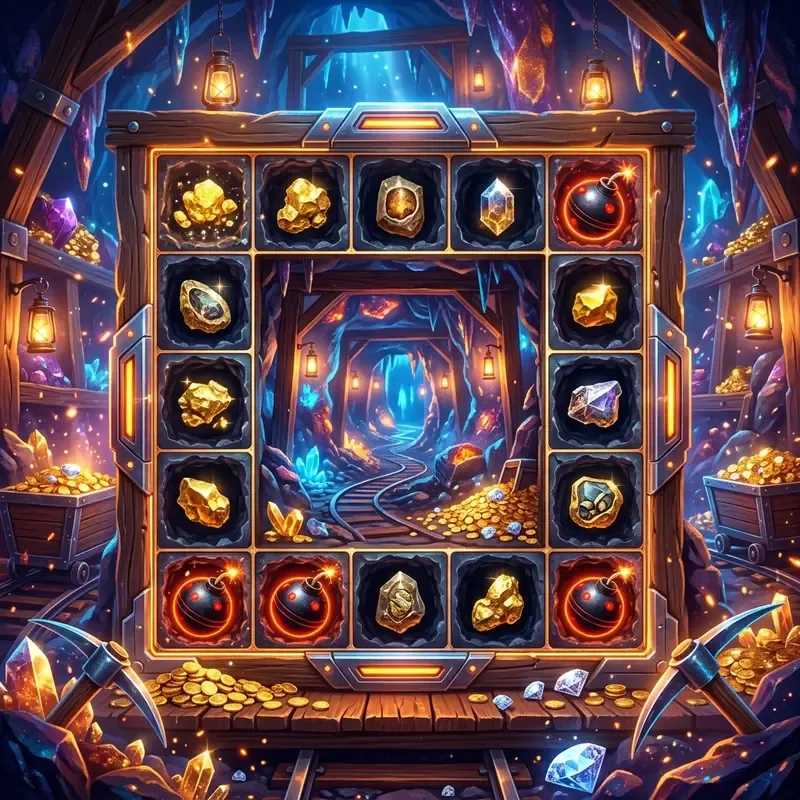
Provider

Spribe

RTP

97.00%

Volatility

Medium

Min bet

$0.01

Max bet

$100+

Max win

5,000,000x
Mines Game Full Guide to Rules

Mines in Canada: CAD stakes, Interac withdrawals and who regulates play

Before the maths, the practical question a Canadian reader usually asks first: can I play Mines legally, in Canadian dollars, and get paid out without a two-week wait?

Short answer: it depends on your province and on the operator's licence.

  • Ontario. Casino products, including grid games like Mines, are offered through operators registered with the AGCO and contracted to iGaming Ontario. Age limit: 19+. Demo play is often hidden from logged-out visitors in this market, and RTP variants can differ from the global build.
  • Quebec. Loto-Québec runs Espacejeux; the provincial age threshold is 18+.
  • British Columbia, Alberta and the Prairies. BCLC (PlayNow), AGLC and provincial equivalents operate the regulated channel; offshore sites sit in a grey zone that Canadian courts have never fully settled.
  • Everywhere else. Many Canadians play on internationally licensed platforms. That is not the same protection as a provincial regulator, so the complaint path matters as much as the bonus.

Payments are where the experience actually gets judged. Interac e-Transfer and Interac Online remain the default for CAD deposits, usually credited within minutes. Withdrawals are slower by nature: expect a pending review window, then 1 to 3 business days for Interac, often faster for e-wallets such as MuchBetter or Skrill, and up to five days for card refunds. Crypto rails settle quickest on Provably Fair platforms, but they add currency risk.

Four checks before you deposit:

  1. Confirm the licence and, if you are in Ontario, the AGCO registration.
  2. Find the cashier page and confirm CAD is supported natively, not converted at a hidden rate.
  3. Read the withdrawal section: minimum, maximum, and whether KYC is done before or after your first cash-out.
  4. Open the bonus terms and locate the game-weighting table. Mines is frequently weighted at 0%.

Do those four things and most of the horror stories stop happening to you.

Mines in Canada CAD stakes, Interac

Key insights and takeaways for Mines online

Mines is a fixed-odds, RNG-driven grid game. It looks like the classic Minesweeper, but it removes the deduction layer: nothing on the board gives you information about where the mines are. Every click is an independent draw from a known probability distribution, and the multiplier you are offered is simply the mathematical inverse of the survival probability, scaled by the game's RTP.

Three practical takeaways sit at the centre of this guide:

  • Configuration changes volatility, not RTP. Choosing one mine or twenty mines does not make the game "more generous". It changes the shape of the outcome distribution while the return to player stays at the provider's fixed level.
  • There is no optimal cash-out point in expected-value terms. Cashing out after one tile and cashing out after ten tiles have the same expected value; they differ only in variance.
  • Free play is not a rehearsal for real play. Behaviourally, it is a gateway. Demo modes replicate the maths but not the financial consequences, and the research literature treats that gap as a risk factor rather than a training benefit.
Key insights and takeaways for Mines

«17% of the total sample and 54% of problem gamblers were "quite sure" or "convinced" that simulated gambling led them to bet with real money.» Source: representative study of simulated gambling, Journal of Gambling Studies.

That figure matters because demo Mines, social-casino Mines and sweepstakes Mines can, for some players, form part of a trajectory towards real-money play rather than a safe alternative to it.

On the payout side, Mines belongs to a category of instant-win products marketed on unusually high theoretical returns. Academic work on crash-style games makes the comparison explicit:

«The game displays an unprecedented 97% RTP compared with 91–92% for Atlantic City casino slots and 92–96% for Las Vegas slots.» Source: The Rocket: Analyzing RTP, Payoff Distribution and Player Behavior in Crash Games, International Conference on Gambling & Risk Taking.

A 97–99% RTP genuinely is a low house edge per round. It is also, in behavioural terms, an invitation to play faster and longer, which is how a 1–3% edge is converted into real losses.

What Mines is: the general structure of Mines as a casino game

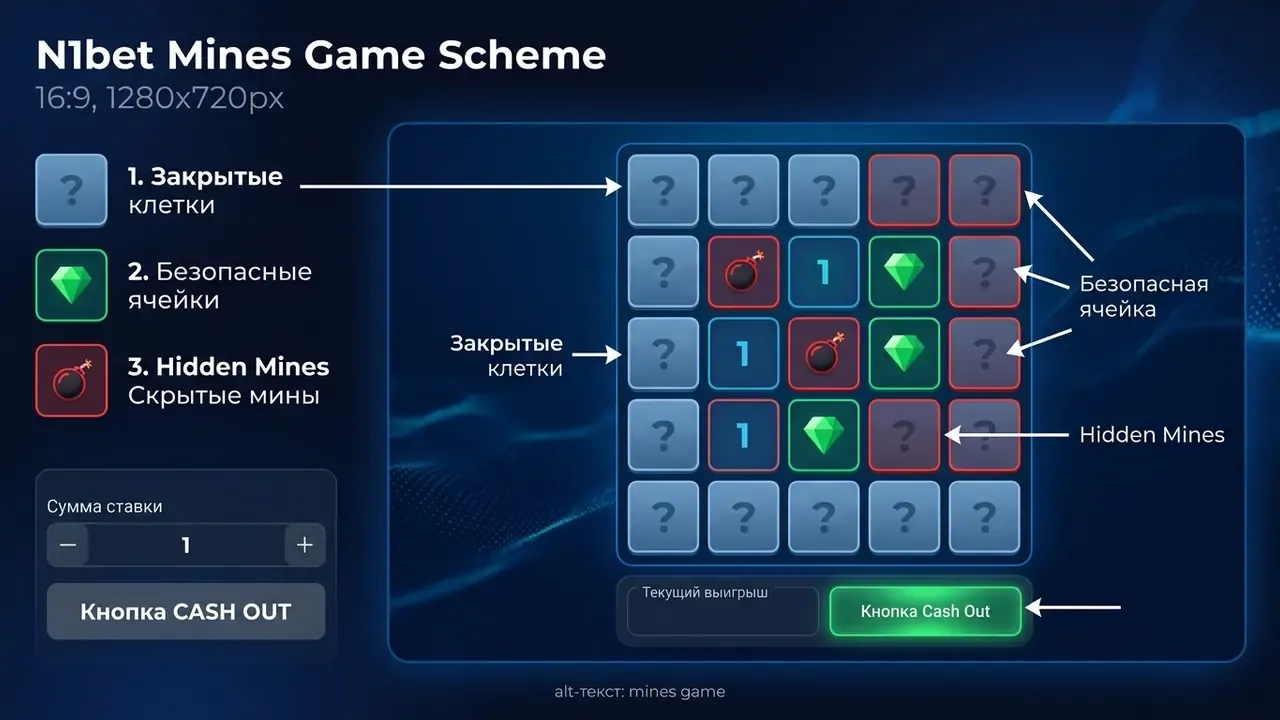
Mines is a hidden-information game on a grid of covered tiles, typically implemented as a 5×5 board of hidden tiles in most online casino lobbies. Before the round begins you choose a stake and a mine count. The software then places that number of hidden mines at random positions; the remaining tiles are "safe" and usually shown as gems or diamonds.

You reveal tiles one at a time:

  • A safe tile keeps the round alive and increases the current multiplier.
  • A mine ends the round immediately and the stake is lost.
  • A cash out is available after any successful reveal, paying stake × current multiplier.

The crucial difference from the original Minesweeper is informational. In Minesweeper, numbers on revealed squares tell you how many mines are adjacent, so skilled deduction genuinely improves results. In casino Mines there are no numbers, no adjacency hints and no deducible pattern. The skill component is reduced to risk selection: how many mines you place on the board, how many tiles you intend to open, and when you stop.

Mines sits conceptually in the broader family of crash-style and instant-win games, but its decision structure is distinctly different. Crash games ask for a single exit decision per round; Mines fragments that decision into a chain of small ones.

What Mines is the general structure

«Crash requires one cash-out decision per round, whereas Mines involves up to twenty-four sequential decisions with explicit feedback after each one.» Source: comparative analysis of crash games and Mines, crashedge.com.

That fragmentation is the reason Mines feels like a game of control and judgement even though it is a fixed-odds product. Each successful click delivers immediate positive feedback, and each feedback event invites one more click. One more. Then one more.

Correct terminology

Mines is a grid game (instant-win / specialty category). It has:

  • a grid (board) of tiles (cells),
  • a mine count setting,
  • a multiplier that grows with each safe reveal,
  • a cash-out button.

It does not have reels, rows-and-reels paylines, spins, scatters or bonus rounds. Descriptions of Mines as a "5 rows, 5 reels" slot, as seen in some casino catalogues, are a copy-paste artefact from slot templates rather than a description of how the game works. See Appendix A.

Grid mechanics: board sizes, hidden mines and how multipliers are formed

Board sizes

  • 5×5 (25 tiles). The industry standard, used by Stake Originals, Spribe and Nyx implementations. Mine count is selectable from 1 to 24.
  • 3×3 (9 tiles). An ultra-short format found in Hacksaw Gaming's configurable version; fewer tiles mean steeper multiplier growth per click.
  • 7×7 (49 tiles) and 9×9 (81 tiles). Larger boards in the Hacksaw build, where each individual reveal is safer but each reveal also pays less, so reaching a large multiplier requires a much longer chain of clicks.

How mines are placed

Mine positions are generated at random before your first click and are fixed for the duration of the round. This is the technically important point: the layout does not move in reaction to your clicks. On Provably Fair platforms, that claim is not a promise, it is verifiable, because the pre-round commitment (a hash of the server seed) can be checked against the post-round reveal. The Provably Fair section below walks through the steps.

How the multiplier is formed

For a 5×5 grid with m mines, the probability of surviving k consecutive safe reveals is:

P(k) = C(25−m, k) / C(25, k) = the product of (25−m−i) / (25−i) for i = 0 … k−1

The multiplier offered at that point is:

Multiplier = RTP / P(k)

So a 99% RTP game pays 0.99 / P(k), and a 97% RTP game pays 0.97 / P(k). Everything else, whether that is grid size, mine count, click order, corners or centre, flows out of that one formula. Selecting the four corners is mathematically identical to selecting four tiles in the middle.

Mines by provider: Stake Originals, Hacksaw Gaming, Spribe, Nyx and others

Most guides quote a single RTP figure for "Mines" as if there were one game. There isn't. Mines is a game format, implemented independently by multiple studios with different RTPs, grids and limits. Quoting 99% when a reader is about to open a 96% version is a material error, not a rounding one.

Provider / versionRTPGridMine countMax winNotable features
Stake Originals, Mines99% (1% house edge)5×51–24Very high, effectively capped by table limitsProvably Fair, auto-bet, custom scripts, manual tile selection
Hacksaw Gaming, Mines98% (tested across ~10,000,000,000 simulations)3×3, 5×5, 7×7, 9×91–88 depending on grid sizex10,000Configurable grid, presets of 1/3/5/7 mines plus custom, HTML5, $0.20–$1,000 bet range
Spribe, Mines97%5×51–24Provider-dependent"Quick Open" random/pattern reveal, heavily marketed in 2026 casino lobbies
Nyx (e.g. BetMGM lobby), Mines96% (may vary by jurisdiction)5×5Fixed configurationx10,000$0.20 min bet, $1,000 max bet, regulated-market build

Two clarifications that competitor articles omit:

  1. The 98% figure is Hacksaw-specific. It is a legitimate number for that studio's build, verified by simulation, but it does not describe every Mines game in a casino lobby.
  2. The 99% figure is Stake Originals-specific. It is achievable because the house edge on Stake's in-house originals is set to 1%. Presenting 99% as "the RTP of Mines" is inaccurate for every other implementation.

Always read the game's own info panel before your first real-money round. The RTP is disclosed there, and regulated markets, Ontario included, sometimes ship a lower-RTP variant of the same title.

Two clarifications that competitor articles omit

Probability and multiplier tables for the 5×5 grid

No competitor publishes this data. It is the single most useful thing a player can look at before choosing a configuration.

Standard configuration: 5×5 grid, 3 mines (99% RTP)

Tile openedChance this click is safeCumulative survival chanceMultiplierChance of hitting a mine on this click
1st88.0% (22/25)88.0%x1.1212.0%
2nd87.5% (21/24)77.0%x1.2912.5%
3rd87.0% (20/23)67.0%x1.4813.0%
4th86.4% (19/22)57.8%x1.7113.6%
5th85.7% (18/21)49.6%x2.0014.3%
6th85.0% (17/20)42.1%x2.3515.0%
7th84.2% (16/19)35.5%x2.7915.8%
8th83.3% (15/18)29.6%x3.3516.7%
9th82.4% (14/17)24.3%x4.0717.6%
10th81.3% (13/16)19.8%x5.0018.8%

Read the third column, not the second. After ten successful clicks with three mines on the board, you have survived a sequence whose probability was under 20%, and the per-click odds looked comfortable the whole way. That gap between "each click feels safe" and "the chain was unlikely" is the whole psychology of the game.

Multipliers by mine count (99% RTP, 5×5)

Tiles opened1 mine3 mines5 mines10 mines20 mines
1x1.03x1.12x1.24x1.65x4.95
2x1.08x1.29x1.56x2.83x29.70
3x1.13x1.48x2.00x5.00x227.7
4x1.18x1.71x2.59x9.17x2,504
5x1.24x2.00x3.39x17.52capped by max win

Survival probability by mine count (5 safe reveals, 5×5)

Mine countChance of 5 consecutive safe reveals
1 mine80.0%
3 mines49.6%
5 mines29.2%
10 mines5.65%
20 mines≈0.002%

«With 20 mines, the probability of five consecutive safe reveals is roughly 0.003%, while RTP remains around 97% because the multipliers scale accordingly.» Source: probability table for the standard 5×5 configuration.

Our own calculation for a 25-tile board gives 1 / C(25,5) = 1 / 53,130 ≈ 0.0019%. Slightly lower than the quoted figure, then. Either way, the conclusion is identical: high-mine configurations pay enormous multipliers precisely because the outcomes almost never happen.

Mines demo and Mines free: what free play does and does not teach you

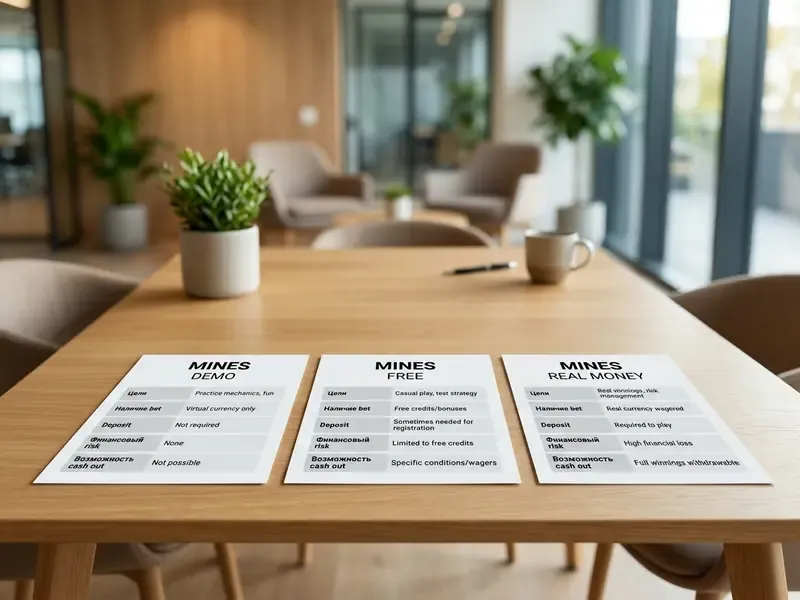
Demo (or "free", or "fun") mode runs the same rules and the same RNG on a virtual balance. Stakes and winnings do not touch real funds, no withdrawal is possible, and availability is operator-specific rather than universal. Some regulated lobbies, Ontario among them, remove demo play entirely for logged-out visitors.

What Mines demo mode is genuinely useful for:

  • Learning the interface: bet field, mine selector, auto-play controls, cash-out button.
  • Seeing how multipliers scale across mine counts before risking money.
  • Testing whether a chosen cash-out point matches your risk tolerance emotionally.

What Mines free play cannot do:

  • It cannot show you a "winning rhythm". Rounds are independent; a hot demo session predicts nothing.
  • It cannot reproduce loss aversion. Play money removes the exact psychological pressure that causes bad real-money decisions.
  • It cannot validate a betting system, because no betting system alters expected value.

The research base is blunt about the direction of travel from free play to paid play:

Mines demo and Mines free what

«17% of the total sample and 54% of problem gamblers were "quite sure" or "convinced" that simulated gambling led them to real-money betting.» Source: representative study of simulated gambling, Journal of Gambling Studies.

That indicates a clear perceived pathway from free or demo-style play to monetary betting. Experimental work also shows that free-play environments are not behaviourally neutral once even trivial rewards are attached:

«Offering small tangible rewards within social casino games increased the number of in-play bets, without directly increasing subsequent real-money gambling.» Source: Offering small tangible rewards within social casino games increases in-play bets, Journal of Gambling Studies.

In other words: reward cues changed how intensively people bet in the free environment, though in that particular study these rewards did not directly increase subsequent real-money gambling.

Playing for real money: bets, deposits and access conditions

Mines real money play requires a registered account, an accepted payment method, a deposit and, in regulated markets, completed identity verification (KYC). Age thresholds vary: 18+ in most European markets and in Alberta, Manitoba and Quebec, 19+ in Ontario and most other provinces, 21+ in several US states.

Typical commercial parameters across operators:

  • Bet range: commonly $0.10 to $0.20 minimum and $100 to $1,000 maximum per round, quoted in CAD on Canada-facing sites.
  • Max win: frequently advertised at x10,000, with maximum advertised multipliers up to 10,000× for highly volatile configurations.
Playing for real money bets, deposits

«Stakes typically range from $0.10 to $100 per round, with a practical maximum win reaching 10,000× on statistically rare long streaks.» Source: operator review of Mines, crashedge.com.

Bonus eligibility is a frequent trap. Because Mines can be configured to an extremely low-variance, high-hit-rate mode, many casinos restrict it from contributing towards welcome bonus wagering requirements, and some terms explicitly list Mines as contributing 0% to bonus rollover. This is stated in individual operator bonus terms rather than in any industry-wide standard, so the practical rule is simple: open the bonus terms, find the game-weighting table, and confirm the Mines contribution percentage before you accept a bonus. Wagering a bonus on a 0%-weighted game is one of the most common causes of forfeited balances. It is also, in my experience of reading complaints, the one that players find hardest to argue after the fact.

A second payment-side note worth flagging. If you deposit by Interac e-Transfer, most Canadian-facing operators will pay withdrawals back to the same rail, and they will want your KYC documents cleared first. Uploading ID before you win, rather than after, is the cheapest way to shorten a payout.

Real-money play on mobile adds an access dimension that the literature treats as a risk multiplier:

Bonus eligibility is a frequent trap

«Smartphone betting provides immediate access anywhere, integrating gambling into everyday life and making self-control harder to maintain.» Source: grounded theory study of smartphone betting among young adults, International Journal of Mental Health and Addiction.

That is precisely the mechanism by which always-available products foster impulsive, frequent betting and make it difficult for individuals to maintain control. Device and platform patterns also carry measurable predictive weight:

«Device type and platform usage patterns predict self-exclusion due to problem gambling among online casino players and sports bettors.» Source: predictive modelling of problem gambling from behavioural tracking data.

In those datasets, casino players using desktop computers and sports bettors using mobile devices showed elevated risk profiles.

Disclaimer. This information is general in nature and does not replace professional advice. Real-money betting carries the risk of losing your entire deposit; check the operator's terms, the game's availability in your province, and applicable legislation before depositing.

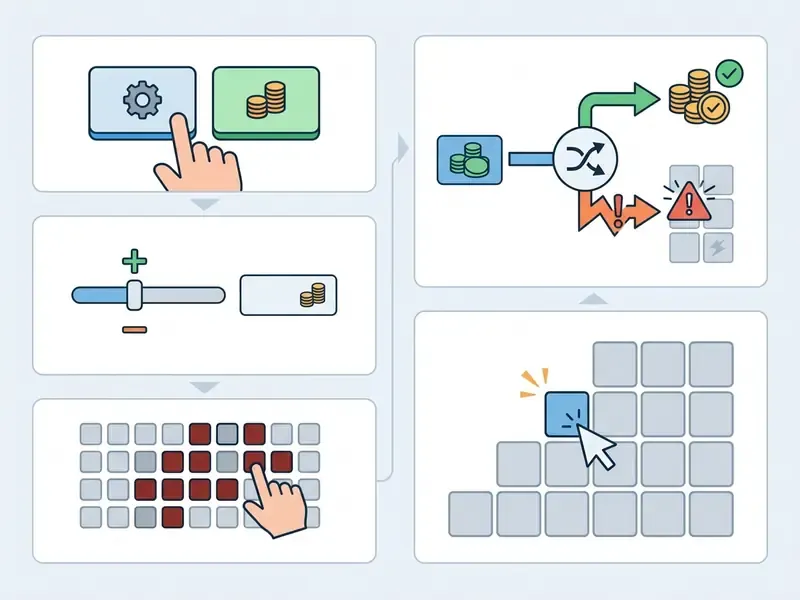
Step-by-step: how to play Mines from bet to cash out

1
Open the game in the casino lobby (category: Originals / Instant Win / Specialty).
2
Confirm the RTP and provider in the info panel. 96%, 97%, 98% and 99% builds all exist under the same name.
3
Set the stake. Fix it in advance as a percentage of your session bankroll, not by feel.
4
Set the mine count. This is your volatility dial: 1 to 3 mines for low variance, 5 to 7 for medium, 10+ for high, 15 to 24 for lottery-style variance.
5
Decide the exit rule before clicking. For example: "cash out at x1.48" or "cash out after three safe tiles". Write it down.
6
Reveal tiles one at a time. Watch the multiplier bar, which shows the current and next multiplier.
7
Cash out at your pre-set point, or lose the stake if you reveal a mine.
8
Log the round. Stake, mine count, exit multiplier, result. Ten minutes of logging tells you more about your own behaviour than a hundred rounds of demo play.

On auto-play

Auto-play (Auto Game) lets you fix a stake, a mine count, a target number of tiles and stop conditions. It does not change any probability. What it does change is speed: auto-play simply executes the same decisions more rapidly and consistently, which compresses the same number of rounds, and therefore the same expected loss from the house edge, into far less time. If you use auto-play, always configure "Stop on Loss" and "Stop on Profit" limits before starting.

The flat-EV property

There is no clever exit point. Formally:

«At 99% RTP, multiplier × survival probability equals 0.99 across all 300 board states, so the expected value is identical at every exit point.» Source: We Solved Mines, analytical study.

Cashing out at x1.03 with one mine and chasing x2,504 with twenty mines have the same expected value, differing only in variance.

Mines strategy: RTP, house edge and strategic limits

RTP and house edge

RTP is the long-run theoretical return: 99% RTP equals a 1% house edge; 97% RTP equals 3%; 96% RTP equals 4%. The edge is applied inside every multiplier, at every step. This is why there is no mathematically optimal selection of tiles, order or mine count.

«Choosing more mines increases the multipliers but does not change the RTP, it only raises volatility.» Source: operator game guides and Mines multiplier calculators.

RTP remains constant regardless of configuration. What changes is the distribution: with one mine you win small amounts very often; with twenty mines you almost never win, but a win is spectacular. Both paths return the same theoretical percentage over an infinite number of rounds.

Why "strategy" in Mines means risk management, not edge-finding

Betting systems cannot create a positive expectation in a game with a fixed probability model, because payouts and odds are set in advance by the paytable formula. Anything marketed as a "winning Mines strategy" is either a volatility preference described as a system, or a scam. There is no third option.

The psychological trap is well documented:

«Misperceptions of randomness and illusion of control are systematically associated with persistence in loss-making behaviour and problem gambling.» Source: research on gambling-related cognitions, peer-reviewed gambling studies literature.

Mines is unusually good at generating that illusion because you pick the tiles. Tile choice feels like agency. Mathematically, it is indistinguishable from being assigned tiles at random.

Fact check. RTP and any strategy do not remove risk. A 99% build still keeps 1% of everything staked, and past results, whether a five-round win streak or a five-round wipeout, do not influence the next round. Each round is drawn independently from the same distribution.

Low risk, more mines and the moment to cash out

Strategy 1: "Minimum risk (1:1)"

  • How it works:1 mine on a 5×5 grid, open 1 to 2 tiles, cash out immediately (multiplier ≈ x1.03 to x1.08).
  • Upside:the round win probability is about 96%.
  • Downside:a single loss wipes out the profit of roughly 12 to 15 successful rounds. Long win streaks feel like a system; the arithmetic of one loss says otherwise.
Strategy 1 Minimum risk 1 1

Strategy 2: "Aggressive multiplier hunter" (more mines)

  • How it works:10 to 15 mines, open only 1 to 2 tiles chasing an instant x3.00 to x10.00 or more.
  • Upside:big payouts from very few clicks; short exposure per round.
  • Downside:extreme volatility and fast bankroll depletion. At 10 mines, two safe reveals happen only 35% of the time.
Strategy 2 Aggressive multiplier hunter more

Strategy 3: "Medium ladder"

  • How it works:3 to 5 mines, a fixed target such as three safe reveals (x1.48 at 3 mines; x2.00 at 5 mines), then cash out unconditionally.
  • Upside:a balanced distribution; disciplined, repeatable, easy to log and review.
  • Downside:still negative EV, because the house edge is untouched.
Strategy 3 Medium ladder

When should you cash out?

Because expected value is flat, the honest answer is: at whatever point you decided on before the round started. The value of a pre-set exit rule is behavioural, not mathematical. It removes in-round decision-making, which is where tilt, chasing and impulsive escalation live.

Two cautions on interpretation. First, RTP figures such as 97% or 99% can be misinterpreted as implying that you will "get back" 97% or 99% of your money quickly. RTP is a long-run theoretical average over enormous sample sizes; over a single session, outcomes are dominated by variance, and the distribution is skewed by design. Second, free or demo success does not predict future real-money outcomes. If you want a platform where limits are visible and easy to configure, prefer a casino with responsible gambling tools over one that hides them three submenus deep.

Loss limits, time limits and self-exclusion mechanisms are essential harm-reduction tools, and the research consensus is that they should not be left entirely to player initiative:

When should you cash out

«Harm prevention should be proactive, drawing on behavioural data and user feedback rather than relying only on player self-regulation.» Source: Gambling harm prevention and harm reduction in online environments, Harm Reduction Journal.

Why Martingale is dangerous in Mines

Several popular guides present the Martingale method, doubling the stake after each loss and reverting after a win, as a "low-risk play". That classification is wrong. Martingale is a high-volatility, high-risk staking pattern that converts many small wins into one catastrophic loss.

The arithmetic, with a $1 base stake:

Consecutive lossesNext required stakeCumulative loss before it
1$2$1
3$8$7
5$32$31
7$128$127
10$1,024$1,023

Three structural problems in Mines specifically:

  1. Table limits. Most implementations cap the bet at $100 to $1,000. Once the required doubling exceeds the cap, the recovery mechanism is mathematically broken and the accumulated loss becomes permanent.
  2. Bankroll limits. Surviving a seven-loss streak from a $1 base requires $255 in reserve plus the ability to stake $128 on a single click. From a $10 base, that becomes $2,550 and $1,280.
  3. No change to expected value. Staking patterns re-slice variance; they never touch the house edge. A negative-EV game staked aggressively is simply a negative-EV game with a fatter left tail.

Also note: a "12×12 minefield" setting circulated in some Martingale guides does not exist in the standard Stake Originals build, which uses a 5×5 grid. If a guide's configuration table does not match the game you are looking at, treat the rest of that guide with scepticism. Safer staking alternatives, such as flat betting, fixed-percentage-of-bankroll, D'Alembert or Fibonacci, reduce ruin risk relative to Martingale, but none of them creates an edge.

Three structural problems in Mines specifically

Bankroll management framework: the four golden rules

  1. The 2% rule. A single bet should never exceed 2% of your session bankroll. With a $100 balance, that is a maximum of $2 per round. This alone makes a 20-loss streak survivable.
  2. Take-profit. End the session at +30% to +50% of the starting bankroll. Unbanked profit is not profit.
  3. Stop-loss. Stop immediately at −40% of the starting balance. Never attempt to recover by increasing stakes; that is the Martingale failure mode with extra steps.
  4. Rule-based auto-play. If you use Auto Game, always set "Stop on Loss" and "Stop on Profit". Also set a session timer, because high-speed games erode time awareness.

A fifth, optional rule that experienced players find most valuable: keep a round log. Stake, mine count, target multiplier, actual exit, result. Deviations from your own plan are the real signal.

Bankroll management framework the four golden

Provably Fair: how to verify every round yourself

1
Before the round, copy the Server Seed Hash from the game's fairness settings.
2
Note your Client Seed and the current Nonce.
3
Play the round and then rotate the seed pair to reveal the unhashed Server Seed.
4
Hash the revealed server seed with any independent SHA-256 calculator and confirm it matches the hash you saved in step 1.
5
Feed server seed, client seed and nonce into an independent Mines verifier (open-source verifiers are published on GitHub) and confirm the reconstructed mine layout matches the board you played.

Myths, "predictors", bots and hacks

  • "Mines predictor" apps and Telegram bots. These cannot work. Mine positions are generated server-side by an RNG and, on Provably Fair platforms, cryptographically committed before your first click. No client-side software can read them. Every "predictor" is either a paid scam, an affiliate funnel, or malware harvesting your casino credentials.
  • "Corner tiles are safer." They are not. Every unrevealed tile carries an identical probability. Patterns, diagonals and "hot zones" are pareidolia.
  • "The game gets easier after a loss streak." Rounds are statistically independent. This is the gambler's fallacy in its purest form.
  • "Low mine counts have better RTP." RTP is identical across mine counts within a given build. Only volatility changes.
  • "A high RTP means I will profit." A 99% RTP means the expected long-run return is 99 cents per dollar staked. More rounds means more certainty of loss, not less.
Myths, predictors , bots and hacks

Mines mobile and Mines download: browser vs app, connection requirements

Mines is built in HTML5, which is why it runs in a mobile browser without installation on Windows, macOS, Android and iOS. There are three practical access routes:

  1. Mobile browser (recommended). No download, no storage cost, instant updates. The most common access method in 2026, and the one most Canadian players use when they compare two or three sites on the same phone.
  2. Operator app (the "Mines download" question). Some casinos ship a native app containing their full lobby, including Mines. There is no legitimate standalone "Mines app" that pays real money outside a licensed operator, so treat any such download as suspect.
  3. Desktop browser. Identical maths; a larger board and clearer multiplier bar.

Connection requirements are modest, since Mines transmits small state updates rather than video, but stability matters more than bandwidth. A dropped connection mid-round is the one genuinely stressful technical scenario: reputable implementations preserve round state server-side so you can resume or auto-settle, and you should confirm this in the game rules before playing on an unstable network. Avoid playing a live round while switching between Wi-Fi and mobile data.

One more check worth ten seconds: confirm the game is actually available in your province's lobby. Titles get delisted, and Mines is not offered everywhere.

Mines mobile and Mines download browser

Behavioural and harmful aspects of mobile access

Constant availability is the defining feature of mobile gambling, and it is also the core harm vector, making it difficult for individuals to avoid gambling and encouraging impulsive, frequent betting.

«Participants described betting in bed, at work and during social events; gambling had become a background everyday activity.» Source: grounded theory study of smartphone betting among young adults, International Journal of Mental Health and Addiction.

Mines is particularly well suited to that kind of interstitial play: a round takes seconds, requires no reading, and produces immediate feedback. That is precisely the profile of a product that fills micro-gaps in the day. Bus stop. Elevator. Ad break.

Intention-based research helps explain who escalates:

«Attitudes, perceived norms and perceived behavioural control significantly predict intentions and actual behaviour in mobile gambling.» Source: reasoned action approach to mobile gambling among college students, Current Psychology.

Higher intention is associated with greater actual gambling. Practical countermeasures on mobile: remove casino apps from the home screen, disable push notifications and promotional emails, set deposit and loss limits at the account level rather than the session level, and use operator time-out or self-exclusion tools early rather than as a last resort. In Ontario, PlaySmart and the provincial self-exclusion register are the obvious starting points.

Gambling behaviour and harm in instant-win and crash-style online games

Disclaimer. This information is general in nature and does not replace professional advice. If you are struggling to control your gambling, please seek professional help.

AI prediction of problem gambling

Operators and regulators increasingly monitor account-level behaviour, implying the use of machine learning models applied to large datasets of online casino behaviour.

«Self-reported problem gambling can be predicted with high accuracy from online casino player tracking data.» Source: Auer & Griffiths, Using artificial intelligence algorithms to predict self-reported problem gambling, Journal of Gambling Studies.

For players, the practical implication is twofold: markers of harm are visible in play data long before a crisis, and if your own log shows escalating stakes, shortening gaps between deposits, or chasing after losses, that is the same signal a model would flag.

Simulated gambling, social casino and free-play modes

Free-play and social-casino formats occupy an ambiguous position: no money is at stake, yet the structural features are identical. Same grid, same RNG, same reward cadence.

«17% of the total sample and 54% of problem gamblers were "quite sure" or "convinced" that simulated gambling led them to real-money betting.» Source: representative study of simulated gambling, Journal of Gambling Studies.

This indicates that more than half of problem gamblers perceive simulated gambling as a causal or contributing factor in their transition to paid play. Experimental evidence adds nuance:

«Small tangible rewards within social casino games increased the number of in-play bets, without significantly affecting subsequent real-money gambling.» Source: Offering small tangible rewards within social casino games increases in-play bets, Journal of Gambling Studies.

So reward cues reliably intensify behaviour within the free environment, without significantly affecting subsequent real-money gambling in that study. A reminder that "free" does not mean "behaviourally inert".

Smartphone betting, mobile gambling and harm reduction frameworks

Effective harm reduction combines product design, operator duty and regulation: publishing genuine RTP, providing deposit, loss and time limits alongside self-exclusion, delivering personalised risk feedback, and enforcing regulatory standards on advertising and bonus offers.

«Harm prevention should include transparent RTP information, self-control tools, personalised warnings and regulatory oversight of advertising.» Source: Gambling harm prevention and harm reduction in online environments, Harm Reduction Journal.

Crash games, RTP and player behaviour

Mines shares its commercial logic with crash games: a low house edge, a player-controlled exit and a very high theoretical ceiling. Academic analysis of the crash format quantifies how unusual those returns are relative to land-based benchmarks:

«The game displays an unprecedented 97% RTP compared with Atlantic City casino slots at 91–92% and Las Vegas slots at 92–96%.» Source: The Rocket: Analyzing RTP, Payoff Distribution and Player Behavior in Crash Games, International Conference on Gambling & Risk Taking.

The behavioural finding is the important part. High RTP is often marketed as favourable to players, but the same literature on payoff distribution and observed play indicates that such games may encourage extended play, faster round cycling and greater risk-taking, because a small per-round edge makes long sessions feel sustainable. Time-on-device, not house edge, is what determines total loss. A 1% edge applied to 500 rounds per hour is not a small number.

Mines adds one further wrinkle relative to crash: its decision structure. Where crash asks for one exit decision, Mines asks for up to twenty-four, each accompanied by an explicit success signal. More decisions and more feedback mean more opportunities for the illusion of control to take hold.

The behavioural finding is the important

Mines FAQ

Do Mines predictors, bots or hacks exist?

No. Every round is generated by an RNG and, on Provably Fair platforms, committed cryptographically before your first click. Predictors, "signal" bots and Telegram hack services are fraudulent, and many exist to steal casino logins or install malware.

Which mine count has the best RTP?

None. RTP is fixed by the build (for example 99% on Stake Originals, 98% on Hacksaw, 97% on Spribe, 96% on the Nyx version) and does not change whether you select 1 mine or 24. Only volatility and win distribution change.

Can I cash out at any point in the round?

Yes. Cash-out is available after any successful reveal, up until the moment you click the next tile. Once a mine is revealed, the round is settled as a loss.

What is the maximum win in Mines?

Commonly x10,000, since Hacksaw and Nyx builds advertise this cap. On builds without a stated multiplier cap, the effective ceiling is set by the operator's maximum payout limit.

Is Mines a slot?

No. It is a grid-based instant-win / specialty game. It has no reels, paylines or spins, and terminology such as "5 rows, 5 reels" in some lobbies is a template error.

Does Mines count towards bonus wagering?

Frequently not. Many operators weight Mines at 0% for rollover purposes. Check the game-weighting table in the specific bonus terms before opting in.

Is there a mathematically best moment to stop?

No. Expected value is flat: multiplier × survival probability equals the RTP at every possible exit point. Choose a target in advance and stick to it for discipline, not for edge.

Is demo Mines identical to real-money Mines?

The rules and RNG are the same; the consequences are not. Mines demo play cannot replicate loss aversion, and research links simulated gambling to later real-money betting for a substantial share of problem gamblers.

Can I play Mines in CAD and withdraw by Interac?

On Canada-facing operators, usually yes. Deposits by Interac e-Transfer clear in minutes; withdrawals typically take a pending review plus 1 to 3 business days. Clear your KYC before your first cash-out request.

Is Mines legal where I live?

It depends on your province and the operator's licence. Ontario regulates casino products through the AGCO and iGaming Ontario at 19+, Quebec runs Espacejeux at 18+, and other provinces operate their own lottery-corporation platforms. Offshore sites are a separate, less protected category.

Conclusion

Mines is one of the most mathematically transparent products in the online casino category. The grid is 5×5 (with 3×3, 7×7 and 9×9 variants at Hacksaw), the mine count is yours to choose, and every multiplier is a direct function of a survival probability you can calculate yourself. Strategies cannot overcome the house edge, a point formalised by the flat-EV theorem.

«At 99% RTP, multiplier × survival probability equals 0.99 across all 300 board states, so no strategy changes the expected value.» Source: We Solved Mines.

That transparency is genuinely valuable, and it is also why the behavioural side deserves equal attention. Mines is a fixed-odds, RNG-driven casino game with constant RTP, sitting in the same commercial family as other fast-cycling iGaming platforms products: high theoretical return, very high speed, and a player-controlled exit that feels like skill.

Free and social versions are not a neutral warm-up, with 17% of all respondents and 54% of problem gamblers in one survey attributing their transition to real-money play to simulated gambling, a finding drawn from a representative study published in the Journal of Gambling Studies. Mobile access compounds the effect by embedding play into ordinary daily routines.

The defensible way to play Mines, if you choose to play at all: verify the provider and RTP in the info panel, know the probability table for your configuration, stake no more than 2% of a session bankroll, set your exit multiplier before the round starts, use stop-loss and take-profit limits, verify a Provably Fair round at least once so you know how, and ignore every product that claims to predict the board.

Compare on the facts, read the terms line by line before you deposit, and play responsibly. 19+ in most of Canada.

That transparency is genuinely valuable, and

Appendix A: corrected competitor claims and terminology notes

Retained here for transparency, since these formulations circulate widely and readers will encounter them elsewhere.

Circulating claimStatusCorrected version (Updated)
"The RTP of this game is 98%, tested over 10,000,000,000 simulations. Provably fair that is!"Supported, but provider-specific98% is the RTP of the Hacksaw Gaming build. Other builds run at 96%, 97% or 99%. "Provably fair" also requires a verification procedure, which the original claim omits; see the Provably Fair section.
"The RTP for Mines is around 99%."Context required99% applies to Stake Originals Mines, where the in-house house edge is set to 1%. It is not the RTP of Mines generally.
"The 'Low Risk Play' strategy involves the Martingale Method… Minefield setup 12×12."Contradictory and dangerousMartingale is high-volatility, high-risk, not low-risk; it fails against table limits and bankroll limits, as set out in the Martingale section. A 12×12 minefield is not a standard Stake configuration, since the standard board is 5×5.
"Mines: 5 Rows, 5 Reels, 96 RTP."Factually incorrect terminologyMines has no reels. It is a grid instant-win game with 25 tiles on the standard board. The 96% figure corresponds to the Nyx build and may vary by jurisdiction.
Pages where the game guide is dominated by platform legal terms and navigationLow informational valueA useful Mines page must cover rules, grid mechanics, provider-specific RTP, probability tables, staking risk, payment and withdrawal reality in CAD, Provably Fair verification and responsible-play tools.