Plinko: How to Play Online for Free and for Real Money (2026 Guide for Canada)

Last updated: February 2026 · Reviewed for: Canadian players (19+, or 18+ in Alberta, Manitoba and Quebec) · Format: Free demo + real-money guide

Plinko is an arcade-style online casino game where a virtual ball drops through a triangular grid of pegs and lands in a payout slot at the bottom. The mechanics blend physics-inspired trajectory visuals with certified random number generators (RNG), which is how the same board can offer flexible risk levels and return-to-player (RTP) figures between 96% and 99%.

Short version? The board looks like skill. It isn't.
Plinko How to Play Online for

"A Plinko board looks like pure physics, but under the hood, every drop is governed by random number generators and fixed mathematical models. The key for Canadian players isn't chasing a magical bounce. It's understanding how rows and risk levels shape your variance before placing a single dollar." - Reid Calloway, Independent Casino Analyst.

Why This Matters Before You Deposit

If you play in Canada, three things decide whether a Plinko session ends well: the configuration you pick, the terms attached to your bonus, and whether the operator can actually pay you out in Canadian dollars. The game maths is public and fairly simple. The contract around it is where people lose money without ever seeing a bad bounce.

So this guide runs in that order: mechanics first, then providers, then play, then the money side, then the honest limits of any Plinko strategy.

What This Guide Covers

  1. What Plinko is and how the game works
  2. Top Plinko variants and software developers
  3. How to play Plinko online
  4. Plinko mobile and download: browser vs app play
  5. Plinko demo: how to play free without risk
  6. Plinko casino and real money play (CAD, Interac, checklist)
  7. Rows, risk levels, and multipliers
  8. Plinko strategy: can you increase your odds?
  9. FAQ
  10. Key takeaways and next steps

How We Tested (Methodology Note)

Our editorial protocol for arcade-style titles follows four repeatable steps, so every number below can be re-checked by a reader:

  1. Demo distribution testing: at least 1,000 recorded demo drops per configuration (8, 12, 14 and 16 rows across Low, Medium and High risk), logging the landing slot of every ball.
  2. Long-run simulation: a minimum of 10,000 simulated drops per board size, to get a stable estimate of slot-hit probability rather than a session snapshot.
  3. Terms audit: line-by-line reading of bonus terms for playthrough multiples, arcade contribution weight and maximum bet caps.
  4. Cash-out audit: verification of payment rails, KYC steps and stated withdrawal windows for CAD accounts.

Where a figure could not be verified against a published method, we mark it as no data rather than dressing it up.

How We Tested Methodology Note

What Is Plinko and How the Game Works

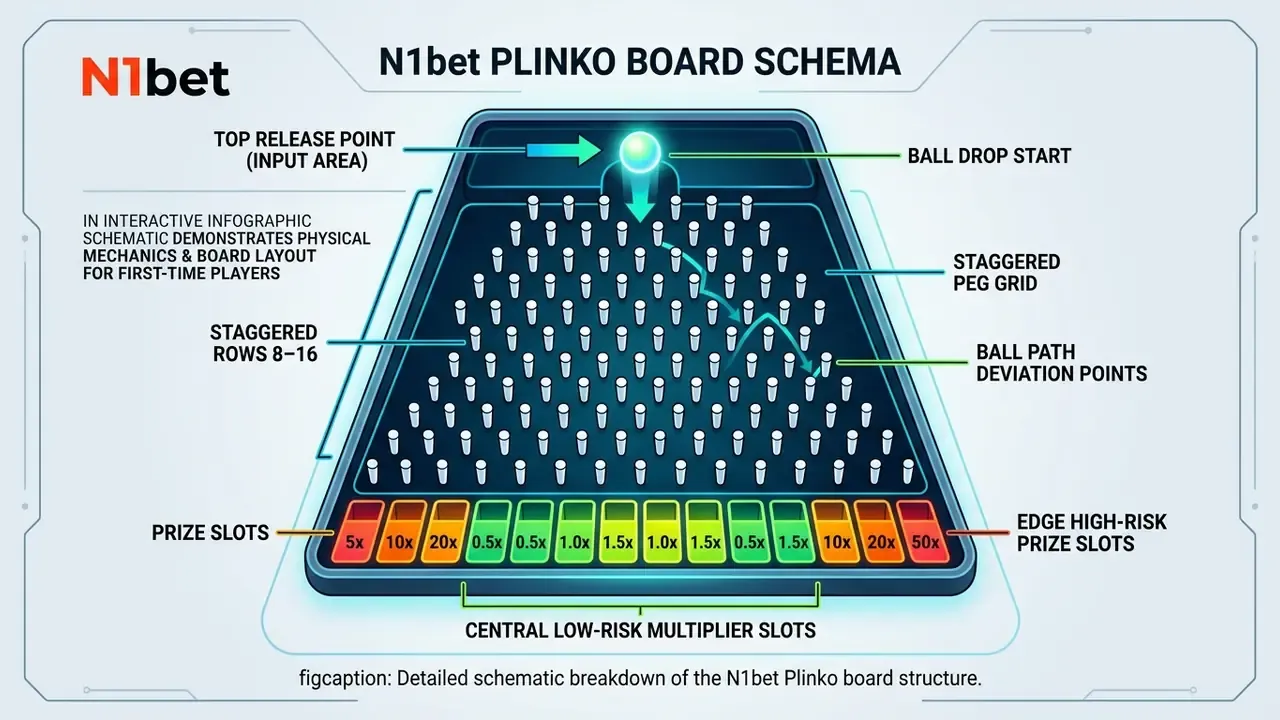
Plinko is a chance-based casino game built on a vertical board with rows of staggered pegs and a line of payout multiplier slots along the bottom. The principle comes from the physical Galton board: as the ball falls under simulated gravity, every contact with a peg forces a binary deflection left or right, building a probabilistic path towards the base slots.

In modern digital casino software, the plinko game runs as a standalone arcade title rather than a traditional payline slot. The layout forms a pyramid. The top release point narrows to a single drop line, while the base widens to hold between 9 and 17 target multiplier slots, depending on the row configuration. Central base slots carry small return multipliers, often between 0.2× and 0.9×, while the outer edge slots hold the headline prizes, reaching 1,000× or even 10,000× stake value.

In plain language: the middle of the board is where almost every ball ends up, and the middle pays little or nothing back. The far left and far right pockets pay the big multipliers precisely because balls almost never reach them.

What Is Plinko and How the

Historical origin and the "hot board" myth Plinko was created by The Price Is Right producer Frank Wayne and debuted on the American game show on January 3, 1983, under host Bob Barker. The show itself first aired in 1956 and adopted its now-iconic One Bid / Pricing Games / Showcase Showdown structure in 1972, with Drew Carey taking over as host in 2007. On the physical TV board, contestants could nudge the outcome slightly by choosing where along the top rail to release the chip. Digital casino Plinko removes that lever entirely: each drop is an independent RNG draw. Warning on "hot/cold" trackers: some providers show live RTP dashboards or a record table of recent results, which can suggest a board is "due" for an edge payout. Because every drop is an independent trial with fixed probabilities ($p = 0.5$ per deflection), past results carry zero predictive value for the next ball.

How the Ball Passes Through the Pegs into a Prize Slot

Simple version first. Each time the ball touches a peg, it goes left or right, roughly a coin flip. After 16 coin flips, ending up with a near-equal number of lefts and rights (the middle of the board) is extremely common. Getting 16 rights in a row (the far edge) is extremely rare. That single sentence explains the entire payout table.

Technical version, for the numbers-driven reader. The trajectory of the ball through the pegs is a sequence of independent statistical events, where each contact alters direction and momentum. On physical Galton boards, a symmetric peg arrangement yields a classic binomial distribution of terminal positions, described by parameters $n$ (number of peg rows) and success probability $p = 0.5$ for left versus right deflections.

How the Ball Passes Through the

«The variance of a binomial distribution equals np(1−p); on a symmetric board with p = 0.5 it equals n/4, so the spread of landing positions grows in proportion to √n as rows are added.» - Stanford University Probability Lecture Notes, Bernoulli and Binomial Variance. https://web.stanford.edu/class/archive/cs/cs109/cs109.1218/lectures/

When the ball hits a peg, the collision response is set either by physics engine parameters, such as restitution coefficients (how "bouncy" the collision is) and tangential friction (how much sideways grip the surface applies), or by an underlying RNG draw mapped directly to a pre-selected landing slot. As the ball descends through $n$ rows, the count of right deflections fixes its horizontal displacement. Because middle landing positions can be reached through hundreds of unique peg path combinations ($\binom{n}{k}$), the central prize slots collect the vast majority of drops. Extreme outer slots have exactly one possible path, all left or all right, which is why high-multiplier prize hits are mathematically rare.

When the ball hits a peg

«As rows of pins are added to a Galton board, the distribution of balls converges ever more closely to the normal distribution, illustrating the central limit theorem.» - UCLA Statistics Online Computational Resource, Galton Board Applet. http://www.socr.ucla.edu/htmls/SOCR_Experiments.html

One small observation from logging demo runs: on an 8-row Low-risk board, the two centre pockets absorbed the clear majority of balls, and the session felt almost flat. On 16 rows at High risk, the same stake produced long dry stretches. Same RTP, entirely different experience.

Top Online Plinko Game Variants and Software Developers

All Plinko games share Galton-board mechanics, but structural parameters differ a lot by studio: maximum multipliers, row limits, RTP. Checking which provider built the title you are opening is the fastest way to know your real ceiling before you stake a dollar.

Software DeveloperMax MultiplierActive Row RangeTheoretical RTPUnique Game Features
Spribe (Plinko Classic)555×12, 14 or 1697.00%Three colour-coded drop buttons (Green = low, Yellow = medium, Red = high) for instant risk selection; provably fair verification per ball.
BGaming (Plinko)1,000×8 to 1699.00%Highest published market RTP; Manual/Auto bet modes, on-screen record table of past results and live RTP tracking in the provider hub.
Stake Originals (Plinko)1,000×8 to 1699.00%Highly customisable animation speed, instant skip, fully open Provably Fair seed verification tool.
Gaming Corps (Pine of Plinko / Xmas Plinko)10,000×+Dynamic~96.20%Combines classic peg drops with slot-style bonus stages and progressive feature triggers; seasonal editions.

Practical reading of the table. A 99% RTP title (BGaming, Stake Originals) has a 1% house edge. A 96.2% feature-driven title carries a 3.8% edge, but a far higher theoretical ceiling. Spribe compresses the whole risk decision into a colour: Green pays near your stake in the centre and roughly 18×–35× at the edges, Yellow stretches edge pockets to roughly 55×–118×, and Red drops centre pockets to as little as 0.2× in exchange for the 555× cap. To reach that Spribe cap you need the maximum 16-row board and a Red ball landing in the extreme outer pocket. A single-path outcome, in other words.

A note on branded variants. Titles like Pine of Plinko bolt slot-style features onto the peg drop, so part of your theoretical return sits inside bonus stages rather than the base board. Different plinko games, different balance of base game and feature play, and the published RTP is the number that reconciles them.

Practical reading of the table. A

How to Play Plinko Online

1
Select stake size: choose your wager per ball in CAD (for example $0.20 to $100) inside your pre-set budget limit.
2
Set the row count: adjust the grid between 8 and 16 rows, or pick from fixed 12/14/16 options depending on the provider. More rows means more bottom slots and a wider multiplier spread.
3
Choose the risk tier: toggle Low, Medium or High to redefine the payout multipliers across the bottom slots.
4
Select launch mode: manual single drops, or an automated series (Auto Mode) with a target count of sequential balls.
5
Initiate the drop: press the launch button to release the ball from the top of the plinko board.
6
Confirm outcome and balance: watch the landing slot. The stake is instantly multiplied by that slot value and credited to your balance, and a winning drop shows up in the round history.

Plinko Mobile and Download: Browser vs App Play

Most Canadian players decide where to play at the same time as they decide how to play, so it is worth settling the device question before real money is involved.

Plinko online is fully optimised for mobile through responsive HTML5 builds, so there is no mandatory download. Native mobile applications, whether a PWA or an iOS/Android build, run identical mathematical mechanics while adding localised push notifications and tidier account management. A plinko app is a delivery wrapper, not a different game.

«A Plinko physics simulator built with p5.js and Matter.js shows that thousands of dropped particles form a recognisable normal distribution, visually illustrating the central limit theorem.» - Plinko Physics Simulator (Matter.js educational build). https://github.com/topics/plinko-physics-simulator

That matters for plinko mobile play: the bounce you see on a phone screen is a rendering layer over the same distribution. A smoother animation in a native app does not change a single probability.

When choosing an access format, weigh performance against safety:

  • HTML5 mobile browser play:launches instantly in mobile Chrome or Safari on iOS and Android. No local storage, automatic updates, full HTTPS/TLS encryption.
  • Progressive Web Apps (PWA):web-based shortcuts saved to the home screen. App-like responsiveness without third-party store approval.
  • Native apps and APK installations:installed via the Apple App Store or a direct Android Package (APK) download. Android controls installation through the package installer and app signing, so an APK is only as safe as its publisher signature. Verify that the file comes from a verified publisher, that it matches the expected developer signing certificate, and that it does not request unnecessary permissions (contacts, SMS, accessibility). If the operator cannot show a signed, checksum-verifiable file, stay in the browser.
N1bet heading-banner
FormatInstall neededStorage usedUpdate pathMain risk to check
HTML5 browserNoNoneAutomatic server-sideOnly that the URL is the licensed domain
PWA / home-screen appShortcut onlyMinimal cacheAutomaticShortcut pointing to a mirror domain
App Store / Google Play appYes30–150 MBStore-managedRegional availability of gambling apps
Direct APK sideloadYes30–150 MBManual re-downloadUnsigned or repackaged files, excess permissions

One more practical point for plinko download decisions: check that the app supports the same CAD cashier and the same responsible-gambling limits as the desktop site. If deposit limits live only on the web version, the app is the weaker choice.

Plinko Demo: How to Play Free Without Risk

A Plinko demo is a free-play mode with virtual credits, letting you test mechanics, row structures and risk settings without risking real money. In a certified plinko free demo, the return model, peg layout and outcome distribution match the real-money version exactly.

Free plinko lets you judge interface responsiveness and watch balance variance across long drop sequences. Since no deposit and often no registration is needed on independent testing portals, the demo works as a training environment for seeing how each parameter changes payout frequency.

What You Can Test in the Free Plinko Demo

A demo session is enough to test several concrete hypotheses about grid setup and session stability:

  • Grid size variance:compare 8-row setups against 16-row layouts across 500 virtual drops, and watch how extra pegs widen outcome dispersion.
  • Risk tier impact:switch Low to High at identical stake sizes to measure how central loss frequency rises in exchange for outer prize availability.
  • Auto-bet series behaviour:run 50 to 100 automated drops to see how quickly balance swings appear under different volatility settings.
  • RTP consistency:track cumulative returns across thousands of demo rounds and watch the realised return drift towards the theoretical 96%–99% mark.
What You Can Test in the

«Physics-oriented analysis recommends running at least 10,000 simulations to obtain a stable estimate of the probability of landing in each slot.» - Realistic Physics in Plinko Games (educational analysis). https://plinko-game.com/physics/

Put differently: 50 demo drops tell you how the interface feels, 10,000 tell you how the maths behaves. Do not conclude anything about "which risk level pays better" from a short run. That is exactly the sample size at which variance masquerades as a pattern.

How to Verify Game Fairness Using Provably Fair Cryptography

Unlike traditional online video slots, certified casino Plinko often uses Provably Fair cryptography (SHA-256), which lets you check that every bounce was random and untouched. To be precise: Provably Fair does not create randomness, the RNG does. It proves the operator did not alter the seed or the result after your bet was accepted.

  1. Locate bet seeds: before dropping, open game settings and copy your Client Seed (generated by your browser, editable by you) and the hashed Server Seed (published by the casino in advance).
  2. Execute the drop: run the round. The outcome comes from combining both seed strings with the round counter: SHA-256(Server Seed + Client Seed + Nonce).
  3. Verify hash match: open the Provably Fair widget or an external SHA-256 calculator, paste the revealed unhashed Server Seed together with your Client Seed, and check the resulting hash against the pre-round hash. A match proves the outcome was fixed before your bet and not altered mid-drop.

If a platform advertises "provably fair" but shows no seed pair, no nonce and no verification page, treat the claim as marketing, not cryptography.

How to Verify Game Fairness Using

Plinko Casino and Real Money Play

Playing Plinko for real money at a licensed online casino means depositing actual funds, choosing a risk level you can live with, and cashing out through a secure method such as Interac or an e-wallet. Unlike demo sessions, real money play puts your bankroll at genuine risk, which raises the bar on licensing checks and platform integrity.

The 4-Step Check Before Any CAD Deposit

Run this checklist first. It takes under five minutes and heads off the two most common Canadian complaints, blocked withdrawals and forfeited bonuses.

  1. Licence check: find the operator's licence in the site footer and cross-check the registry. Ontario residents should see an iGaming Ontario / AGCO registration; elsewhere you will typically see MGA, Curaçao or Kahnawake credentials.
  2. CAD and Interac check: confirm the account can be held in Canadian dollars, and that Interac e-Transfer (or iDebit/Instadebit) works for withdrawals, not deposits only. Deposit-only rails are a red flag.
  3. KYC and limits check: complete identity verification before you win, and read the stated minimum and maximum withdrawal per transaction and per week.
  4. Bonus terms check: read the arcade/instant-game contribution weight and the maximum bet cap during bonus play, or decline the bonus entirely. See the "take or skip" table below.
The 4-Step Check Before Any CAD

Payment Methods and Withdrawal Windows for Canadian Players

These are typical industry processing windows for CAD accounts after KYC approval. Exact limits and timings are operator-specific and should be confirmed in the cashier before you deposit.

MethodDepositWithdrawalTypical payout windowNotes for Canada
Interac e-TransferYesYes~1–24 hoursThe default Canadian rail; low minimums, CAD-native, no currency conversion.
iDebit / InstadebitYesYes~24–48 hoursBank-linked alternative where direct Interac payouts are unavailable.
Credit / debit cards (Visa, Mastercard)YesOften notn/a (payout rerouted)Many issuers decline gambling transactions; payouts usually redirected to bank or e-wallet.
E-wallets (Skrill, Neteller, MuchBetter)YesYes~0–24 hoursFastest option, but some operators exclude e-wallet deposits from bonuses.
Crypto (BTC, ETH, USDT)YesYes~10 minutes–2 hoursCommon on offshore Plinko platforms; adds exchange-rate volatility on top of game volatility.
Bank wire / EFTYesYes~2–5 business daysHighest limits, slowest clearance; usually reserved for large cash-outs.

Where Canadians Legally Stand: Provincial Snapshot

RegionRegulator / platform modelMinimum age
OntarioiGaming Ontario under AGCO (registered private operators)19+
QuebecLoto-Québec (Espacejeux)18+
AlbertaAGLC (PlayAlberta)18+
ManitobaManitoba Liquor & Lotteries / PlayNow18+
British Columbia, Atlantic provinces, Prairies (excl. AB/MB)Provincial lottery corporations; offshore operators licensed by MGA / Curaçao / Kahnawake19+

Legal disclaimer: This information is general in nature and does not replace advice from a lawyer or a responsible-gambling professional. Availability of Plinko casino games, deposit rules, promotional offers and real money play all depend on your province, your age and the terms of the specific platform. Online gambling legislation differs by province and changes over time; verify current rules for your own jurisdiction before depositing.

E-E-A-T compliance note: Real-money online gambling in Canada is limited to players of legal age (19+ in most provinces; 18+ in Alberta, Manitoba and Quebec). Licensing standards vary by jurisdiction: platforms operating in Ontario must hold a licence from iGaming Ontario (AGCO), while offshore platforms often hold licences from the Malta Gaming Authority (MGA) or the Curaçao gaming regime. The UK Gambling Commission requires licensees to keep gambling free of crime and to protect children and vulnerable people, and MGA licensees must run a documented responsible-gaming policy including self-exclusion and age controls. Gambling is an entertainment expense, not a source of income. Set personal deposit limits before you play.

Alternative Play: Sweepstakes and Social Plinko Casinos

For players in jurisdictions where traditional real-money casinos operate under strict limits, and for Canadians who would rather not deposit at all, sweepstakes and social casinos offer a legal route to Plinko:

  • Gold Coins (GC):virtual tokens for free entertainment only. No cash value, no redemption.
  • Sweeps Coins (SC):promotional tokens obtained free via sign-up bonuses, daily logins, mail-in requests, or attached to a Gold Coin purchase. SC won during Plinko rounds can be redeemed for cash prizes or gift cards once the playthrough requirement is met, commonly 1×, sometimes 3×.
  • What to compare:how many Plinko variants are offered (classic Plinko, XY Plinko, multiplier editions, seasonal builds such as Xmas Plinko or Pine of Plinko), whether the welcome offer includes SC with no purchase necessary, app or browser stability, restricted-state and restricted-province lists, and whether rewards continue past the sign-up bonus through daily coin drops or loyalty tiers.
Alternative Play Sweepstakes and Social Plinko

Sweepstakes play removes deposit risk, not variance. The underlying Plinko distribution is unchanged, and SC redemptions still go through identity verification and prize-eligibility rules.

How to Evaluate an Offer Before Making a Deposit

Before claiming any promotional offers tied to Plinko real money play, read three specific clauses in the terms:

  1. Wagering requirements (playthrough): how many times must the bonus be wagered, 35× for instance, before it becomes withdrawable cash? Lower playthrough preserves value.
  2. Arcade/instant game contribution weight: what percentage of a Plinko bet counts towards wagering? Slots often contribute 100%; arcade and instant games frequently contribute 10% to 20%, or nothing at all.
  3. Maximum bet cap during bonus play: keep your stake per ball under the platform's bonus bet limit, typically $5.00 CAD. Exceeding it can void the bonus and everything won with it.
How to Evaluate an Offer Before

«Game documentation must fully explain how the RTP was determined - whether minimum, maximum or average - and how a player can realistically achieve it.» - Connecticut Department of Consumer Protection, Online Casino Gaming Technical Standards (2024). https://portal.ct.gov/DCP/Gaming-Division/Gaming-Division/Online-Casino-Gaming (Note: this standard applies to online casino gaming in general and is not a Plinko-specific study; it is cited here as a regulatory benchmark for RTP and RNG disclosure.)

Worked example of playthrough math. While reviewing casino platforms we found an operator running a 200% match with a 40× playthrough and an instant-game contribution rate of just 10%. The arithmetic is unambiguous. A $50 bonus at 40× requires $2,000 of qualifying volume, and at a 10% contribution weight for arcade titles that becomes $20,000 in actual Plinko turnover. On a 99% RTP configuration, the expected house take across $20,000 of turnover is roughly $200, four times the bonus itself, before variance is even considered. Independent, methodologically documented figures for the exact probability of bankroll exhaustion on High-risk Plinko are not publicly available, so we treat that outcome as highly likely rather than quantified. The practical conclusion holds either way: for a deposit of that size the offer is mathematically unclearable, which is why our tester dropped the bonus and played the raw deposit instead.

Worked example of playthrough math. While
ScenarioTake the bonus?Reasoning
Plinko contributes 100%, playthrough ≤ 25×, bet cap ≥ $5TakeRequired turnover stays within a realistic session volume.
Plinko contributes 10–20%, playthrough ≥ 35×SkipEffective turnover multiplies 5–10×; expected house take exceeds the bonus.
Arcade/instant games excluded from wageringSkip (or play slots instead)Plinko drops contribute nothing to clearance.
Bet cap below your normal stakeSkipOne oversized ball can void the bonus and all winnings attached to it.

Here is what that means for you: a bonus is a contract, and the contribution weight line is usually the clause that decides whether the contract is worth signing.

Rows, Risk Levels, and Multipliers in Plinko

Two user-controlled settings shape the prize distribution: the number of rows (8 to 16, or fixed 12/14/16 depending on provider) and the risk level (Low, Medium, High). Neither changes the underlying RTP. They redistribute variance across the bottom slot array.

Raising the row count adds landing cells and stretches the binomial tail, the thin outer end of the distribution, which makes edge slots exponentially harder to hit. Raising the risk level pushes central cell values down, from around 0.9× to as little as 0.2× stake, while inflating edge multipliers up to 1,000× or beyond.

Risk LevelActive RowsCentral Cell MultipliersOuter Edge MultipliersVolatility ProfilePlayer Use Case
Low8 – 160.5× – 0.9×5.6× – 16×LowSmooth session stability, bankroll preservation
Medium8 – 160.3× – 0.7×13× – 110×ModerateBalanced distribution, moderate payout jumps
High8 – 160.2× – 0.4×29× – 1,000×+Very HighHeavy-tailed variance, rare large payouts

Reading the table in one line: Low risk buys you playing time, High risk buys you a lottery ticket, and the RTP is the same either way.

[⚙️ INTERACTIVE WIDGET: Plinko Expected Value Calculator]
Inputs: Rows (8–16) · Risk (Low / Medium / High) · Stake per ball (CAD)
Output: Expected return across 100 drops, calculated as
Expected Value = Stake × 100 × RTP
Example: $1 × 100 drops × 0.99 RTP = $99.00 expected return, i.e. an expected cost of $1.00 per 100 balls at 99% RTP - before variance.
Markup: figure element with figcaption; all computed values mirrored as plain DOM text for accessibility and indexing.
Reading the table in one line

RTP and Volatility: How to Interpret Game Metrics

Return to Player (RTP) is the theoretical share of total wagered money a Plinko game returns to players across millions of rounds. Commercial Plinko variants from established providers publish baseline RTPs between 96.00% and 99.00%, which corresponds to a house edge of 1.00% to 4.00%. Regulatory frameworks such as the Connecticut Department of Consumer Protection's 2024 online casino technical standards govern how RNG behaviour and RTP figures must be documented and disclosed. They are general online-casino standards, not Plinko-specific research.

Volatility measures how large and how frequent your balance swings are. RTP stays fixed across configurations inside a given title, but volatility shifts hard with rows and risk. On a High-risk 16-row board most drops land centrally and return 20% of the bet, while the average return only approaches 98% over an enormous sample, carried there by rare high-multiplier hits.

RTP and Volatility How to Interpret

E-E-A-T fact check: A high theoretical RTP, 99% for example, does not guarantee a win or a profit in any single session, and multipliers do not promise a winning round. According to guidance from the UK Gambling Commission, RTP is a percentage returned "over a long period of play", calculated across millions of independent drops. For a 96% RTP game, a $1 stake carries an expected return of $0.96. An expectation, not a promise. Short-term results are dominated by variance, and losing streaks occur even on maximum-RTP configurations.

«Changing a game's configuration may change its theoretical RTP, and that change must be reflected in updated player-facing documentation.» - Connecticut Department of Consumer Protection, Online Casino Gaming Technical Standards (2024). https://portal.ct.gov/DCP/Gaming-Division/Gaming-Division/Online-Casino-Gaming

Plinko Strategy: Can You Increase Your Odds of Winning?

Disclaimer: general information only. No betting strategy guarantees profit in games driven by certified RNG. Play responsibly and stake only funds you can afford to lose.

No deterministic system alters the odds or beats the house edge in RNG-certified online Plinko. Each drop is an independent event with fixed probabilities, so mathematical expectation ($\text{EV}$) stays negative across every betting pattern in real money play.

«Every bounce is decided by the provably fair algorithm, not by where the player aims - attempts to "steer" the ball are illusory.» - Plinko RTP and Strategy casino guide. https://plinko-game.com/rtp/

Here is how the usual table-game systems behave once they meet a peg board:

  • Martingale (doubling after losses):stakes double after every losing drop, defined as a return under $1.0\times$. Growth is geometric, so after $k$ consecutive losses the required wager is $2^k$ times the base bet: a $1 opening stake becomes $128 on the eighth loss, $1,024 on the eleventh and $32,768 on the sixteenth. On a High-risk board where most drops return under $1.0\times$, streaks of that length are ordinary, not exceptional. The system collides with either the maximum bet cap or the floor of your bankroll, whichever comes first. In a negative-expectation game with a finite bankroll, geometric bet growth makes eventual ruin near-certain over a long enough sequence. It does not change EV. It compresses many small losses into one large one.
  • Pyramid risk shifting:alternating Low and High risk after set intervals changes the variance profile per round and leaves the cumulative house edge untouched. Moving stakes between risk tiers cannot manufacture positive expectation across independent trials.
  • Fixed bankroll management:staking a fixed 1% to 2% of bankroll per ball does not shift the house edge, but it stretches session length and lowers the chance of rapid exhaustion during a high-variance run. This is the only item on the list that reliably does what it claims.
N1bet heading-banner

The honest framing: strategy in Plinko is budget control, not odds control. You choose how long the entertainment lasts and how bumpy it feels.

FAQ: Quick Answers About Plinko

Is Plinko rigged, or can the outcome be manipulated?

On licensed platforms, no. Outcomes come from certified RNG, and Provably Fair titles let you re-hash the Server Seed, Client Seed and nonce yourself to confirm the result was fixed before your bet. If a site offers neither certification nor seed verification, that is a reason to leave, not a reason to distrust Plinko as a game type.

What is the minimum bet in Plinko?

Most commercial builds accept stakes from roughly $0.10–$0.20 CAD per ball, with maximums between $100 and several hundred dollars depending on the operator and the row/risk configuration. Bonus play usually caps stakes far lower, commonly $5.00 CAD.

Which row count and risk level is "best"?

There is no best setting, only a variance preference. Fewer rows plus Low risk gives frequent small returns and longer sessions; 16 rows plus High risk gives long dry stretches broken by rare large multipliers. RTP is identical across those choices inside the same title.

Do "hot and cold" or live-RTP trackers help me time a drop?

No. Each drop is statistically independent, so a record table of previous results has no predictive value. Trackers are entertainment features, not edge tools.

Can I win real money playing Plinko for free?

Not in a standard demo, which uses valueless virtual credits. In sweepstakes models, Sweeps Coins obtained free can be redeemed for cash prizes once the stated playthrough is met. Gold Coins never can.

Do I need a Plinko download to play on mobile?

No. HTML5 browser play covers iOS and Android, and a plinko app or PWA simply adds notifications and quicker access. Check that any app version carries the same CAD cashier and the same deposit limits as the site.

How long does an Interac withdrawal of Plinko winnings take?

After KYC approval, Interac e-Transfer payouts typically clear within about 1–24 hours at Canadian-facing operators, versus 2–5 business days for bank wires. Confirm the exact window in the cashier, since limits and timings are operator-specific.

Key Takeaways: How to Approach Online Plinko

  • Understand the board:Plinko maps Galton board physics onto certified RNG engines. Central slots hit often for small payouts; outer edge slots pay rarely and large.
  • Know your provider:Spribe caps at 555× with 97% RTP and colour-coded risk; BGaming and Stake Originals publish 99% RTP with 1,000× ceilings; Gaming Corps titles trade RTP for feature stages and 10,000×+ potential.
  • Control your volatility:rows (8–16) and risk tiers act as variance controls without changing the underlying RTP band of 96%–99%.
  • Test in demo:use plinko free demo modes to watch drop distributions and balance swings before depositing CAD, and use thousands of drops rather than dozens.
  • Verify fairness yourself:copy the Client Seed and hashed Server Seed, run the round, then re-hash to confirm the result was predetermined.
  • Evaluate casino terms:check arcade contribution rates before opting into a deposit bonus. A 10% weight can turn a $50 bonus into $20,000 of required turnover.
  • Play responsibly:set strict deposit limits, never chase losses with doubling systems, ignore "hot board" trackers, and keep gaming as entertainment (19+, or 18+ in Alberta, Manitoba and Quebec).
Key Takeaways How to Approach Online

Next Steps

  1. Open a free Plinko demo and log 500 drops on an 8-row Low-risk board, then 500 on a 16-row High-risk board. Compare the distributions.
  2. Run the Provably Fair verification once, so you know the procedure before money is involved.
  3. Work through the 4-step pre-deposit checklist for any operator you shortlist, paying particular attention to Interac withdrawal availability.
  4. Decide in advance on a session budget, a stop-loss and a stop-win figure, and enter them in the Auto panel before the first ball.

Compare on the facts, read the terms before you deposit, and play responsibly. If a session stops being entertainment, provincial self-exclusion tools and deposit limits exist for exactly that moment.

Next Steps. 1. Open a free

Appendix A: Editorial Revision Notes

For transparency: the following statement appeared in an earlier version of this guide and was revised because the underlying figure lacked a published methodology and sample size. "Fulfilling the clause on High-risk Plinko carried a 94% probability of bankroll exhaustion before clearance." The revised passage keeps the verifiable arithmetic ($20,000 required turnover for a $50 bonus at 40× playthrough and 10% contribution weight) and describes bankroll exhaustion as highly likely rather than assigning it an unsourced probability. The earlier inline attribution of the 96%–99% RTP band to the Connecticut Department of Consumer Protection, 2024 Standards has also been clarified: that standard governs RNG behaviour and RTP disclosure for online casino gaming generally and is not a Plinko-specific document.

Appendix A Editorial Revision Notes. For